

Ron Clarke’s Criminological Legacy: In Our Own Words
By Former Students, Co-Authors and Colleagues
Beth Adubato, PhD
Assistant Professor, New York Institute of Technology
“A new term needs to be coined for Ronald Clarke: Innovator Emeritus. Never has he rested on his intellectual laurels. In our countless discussions on new areas for our field, he has pushed me to be creative, to find uncharted territory and to focus on innovations with public policy impact.”
April 5, 2015
Gisela Bichler, PhD
Professor, California State University San Bernardino
“I first learned of Dr. Ronald V. Clarke’s work in 1992. His thoughts on offender decision-making have direct, actionable anticrime policy implications and this inspired me to go to Rutgers University in order to learn from him. For more than 20 years, he has guided my career and his ideas have shaped my work.”
March 25, 2014
Steven Block, PhD
Assistant Professor, Central Connecticut State University
“From the moment I arrived at Rutgers, Dr. Clarke played a vital role in my development as a scholar. The same logical approach that has led Dr. Clarke to be an internationally recognized leader in the field also assisted in my development in the classroom and on research projects. His willingness to invite me to work as a research assistant on a federally funded project led directly to my dissertation work and contributions to the discipline after graduation.”
March 29, 2014
Hervé Borrion, PhD
UCL Jill Dando Institute of Security and Crime Science
“I hope future generations come to truly appreciate just how much of an explorer Ron Clarke was — such an extraordinary investigator of the world around us.”
Kate Bowers, PhD
Professor of Security and Crime Science, UCL, London
“Since 1993 when I first became a research assistant working on issues in environmental criminology and crime analysis I have continued to use research and theoretical concepts developed by Professor Ron Clarke. Ron’s work on rational choice theory and situational crime prevention have undeniably changed the landscape of our research field, and, I truly believe, prevented many crimes against the public.”
March 31, 2014
Additional Reflection (with Shane Johnson):
How Ron Clarke was CRAVED (edited version of presentation to ECCA in Nashville, July 2025)
Ron had an influence on so many of us, and to those of us based at UCL, he was a central figure in the foundation of not only our discipline, but of our home in the form of the Jill Dando Institute and the UCL Department of Security and Crime Science. Without his involvement, we wouldn’t exist in the way that we do as an organisation, or have careers based on the success of a discipline that is founded on his insights on crime as opportunity and situational prevention. There isn’t an academic in our department that hasn’t read his work in order to develop their research or to use it in their teaching and we believe that this will continue to be the case in perpetuity.
In paying tribute to Ron, we will leave it to other colleagues to recount the professional and personal details of his life. Instead, we celebrate the essence of Ron from our point of view by summarising some of his qualities and actions under the acronym CRAVED. This we think is very fitting as Ron himself created this acronym – among notable others – and it has proved very valuable as a tool in the practice of situational crime prevention. Good acronyms are clear, to the point, hard-working and memorable and these qualities were in abundance in Ron. Below, for each letter we propose a quality and give a supporting evidential example (with thanks to some of our JDI colleagues named below for providing some of these).
Ron was:
Clever- with multiple seminal ideas and papers. Ron’s publication list, of course, speaks for itself on this aspect. Kate’s personal example of observing his cleverness was in editing the second version of ‘Seven Misconceptions of Situational Prevention’ with him. His list of the seven major criticisms of the SCP approach, along with logically argued, razor sharp rebuttals that cut through the bullshit, was a sight to behold. If the reader has time to take another look at ‘Table 1’ in that chapter this demonstrates the point: it is both clever and clear.
Rational- understanding the role of opportunities in crime. Gloria Laycock joked that unlike the offenders considered in the rational choice perspective, Ron’s rationality was not bounded. She proposes that he was so supremely rational that, as such, you couldn’t really argue against him. Those that knew Ron will know what she means- he would quietly and patiently explain his point which would be bullet proof and change your thinking about your research or your career path or whatever else your discussion had involved.
Available- to support all colleagues and young careers internationally. Many have commented on Ron’s attention to encouraging and enabling the growth of the careers of those focusing on situational prevention and crime science. He did this in many ways- he must have written hundreds of references for promotion applications and he actively encouraged young researchers who had interesting ideas about ways that situational prevention could be applied. One example is his support of those with an interest in applying SCP to wildlife crime, many of whom are now key figures in the field. Aiden Sidebottom recalls that Ron was hugely supportive of his plans to do a PhD in Malawi. Ron expressed to Aiden that he was keen to see a body of work being built that demonstrated the applicability of SCP in developing countries. Aiden recalls that Ron’s support for his studies came in many ways- in linking him up with like minded people, in sending brief personal notes on his published papers and on one occasion even encouraging Aiden to stay as a guest at his home in New Jersey even though he was elsewhere himself.
Visionary- in identifying new frontiers and forms of offending that would require attention. Shane recalls a conversation with Ron from early in the 2000s where he remarked that we should perhaps be less interested in crimes such as burglary and more interested in new forms of offending such as online crime, which would be a huge future issue- and of course here we are in that reality. Ron wrote with much foresight. Two cases in point here were his 2003 book Superhighway Robbery (e-commerce crime) and Outsmarting the Terrorist from 2006, both co-authored with Graham Newman. Shane now directs the Dawes Centre for Future Crime at UCL which continues this legacy.
Endearing- with his personality characteristics and his love of birds. Ron was rarely openly excited but, as Gloria knows, a good photo of a rare bird would do it. She recalls an occasion when he called her into his office to see something wonderful; which turned out to be a picture of an obscure type of parrot. Another endearing characteristic was his occasional lack of dexterity. We recall him struggling to put his slides the correct way up on overhead projectors at various meetings and, much to our horror, he walked straight into a glass wall in our London offices several times. We subsequently placed stickers on the glass as a form of situational accident prevention.
Determined- wanting to have a long-lasting effect on crime prevention policy and public safety. Despite counter-arguments from many of his colleagues, Ron often felt that SCP still hadn’t gained sufficient traction in the mainstream of government crime prevention policy. Over the years and changing political leadership there is evidence for both viewpoints on this topic. What is apparent though is that Ron’s determination to promote an approach to crime prevention that focuses on the situational factors of the crime event lasted the remainder of his lifetime. It was a noble crusade.
We hope you agree with us that the late Professor Ron Clarke was truly CRAVED. As a final note, we suggest that there is perhaps no universally agreed version of the acronym as applied to Ron. Indeed, on reading our take on it, Nick Tilley pointed out that he would have made some (excellent) alternative points under the version ‘Clear, Realistic, Applied, Value, Even-tempered and Determined’. However we remember Ron individually, it is clear that he has had a lasting influence on many lives and careers, as well as an undeniable hand in helping to make the world a safer place.
Anthony A. Braga, PhD
Don M. Gottfredson Professor of Evidence-Based Criminology / Senior Research Fellow, Rutgers University, School of Criminal Justice / Harvard University, Kennedy School of Government
“His seminal work in the situational analysis of crime problems and his constant push to evaluate implemented crime prevention strategies using a range of methods powerfully influenced my career as an academic. Put simply, his work on offender decision making shaped the development of key concepts in “pulling levers” focused deterrence strategy that have been implemented in multiple U.S. cities and generated large reductions in homicides and serious non-fatal violence.”
March 30, 2014
Additional Reflection:
“Ron was a very kind and supportive mentor to me during the early stages of my career. He shaped my thinking on crime commission and prevention in profound ways. When I first came to Rutgers, my understanding of criminological theory was limited to perspectives that considered individual dispositions towards crime and larger structural factors that influenced criminal behavior. Ron’s teachings on rational choice, situational crime prevention, and problem-oriented policing were a revelation. It was invigorating to learn that criminologists could make practical contributions that led to immediate improvements in public safety. I finally felt that I had a place in criminology and was enthused to pursue applied research that could reduce traumatic victimization and enhance community wellbeing. Equally important, Ron was a kind, supportive, and engaged mentor. He encouraged me to be creative in my thinking on crime prevention and didn’t laugh when I came up with some admittedly awful ideas. He happily agreed to be my dissertation chair. After I left Rutgers to work as research staff at Harvard Kennedy School, Ron contacted me regularly to check in on my progress, set deadlines to encourage timely completion of the work, and provided me with insightful feedback on unfinished chapters. I was incredibly lucky to have his support and encouragement and would probably be still working on the degree if it wasn’t for his compassionate accountability. Ron made me a better scholar and showed me what it meant to be a good mentor to my students. I will be forever grateful to him.”
Anthony A. Braga, Ph.D. Jerry Lee Professor of Criminology Director, Crime and Justice Policy Lab University of Pennsylvania
Patricia Brantingham, PhD
Professor of Criminology, RCMP Chair in Computational Criminology; Director, Institute for Canadian Urban Research Studies (ICURS), Simon Fraser University, Burnaby, British Columbia, Canada
“Ronald Clarke’s work as researcher, scholar, teacher and editor has made him one of the most influential criminologists of the last half century. Ron developed situational crime prevention, brought it to fruition at the British Home Office and expanded its scientific base through Crime Prevention Studies and the ECCA Symposium.”
March 31, 2014
Paul Brantingham, PhD
Professor of Criminology, RCMP Chair in Crime Analysis; Associate Director, Institute for Canadian Urban Research Studies (ICURS), Simon Fraser University, Burnaby, British Columbia, Canada
“Ronald V. Clarke is the originator of the theory and practice of situational crime prevention and a major force in its development as a major stream in modern crime prevention and criminological theory. His impact, both scientifically and practically, has been profound. I strongly support his nomination.”
March 31, 2014
Rick Brown, PhD
Deputy Director (Research), Australian Institute of Criminology
“The work of Professor Clarke has had a significant impact on my own work. Throughout my career I have drawn heavily on his ideas and writing on situational crime prevention, which has informed my writing. Personally, Professor Clarke has been an influential mentor through our collaboration on projects associated with vehicle crime, serious and organized crime and railway suicide.”
July 4, 2014
James D. Calder
Professor Emeritus, Department of Political Science & Geography, The University of Texas at San Antonio
“I met Ron Clarke and Marcus Felson years ago at an invitational conference at the University of Maryland essentially focused on what evolved as his situational crime prevention theory and publications. His words and insights opened eyes, minds, and research opportunities thus allowing for so many new ventures in criminology. Most critically, he pushed, pulled, and dragged criminology and security fields kicking and screaming into a more grounded reality of the day-to-day lives of individuals and communities facing crime conditions. In essence, he was responsible—along with his intellectual progeny—for creating and energizing a new criminological theory more readily applicable to conditions on earth. In doing so, he was responsible for challenging the traditional field of security, enslaved by so many years of narrowly mechanistic concerns for gates, guards, and guns. He exposed the security profession to so many lines of possible inquiry while broadening horizons of investigation and application. As Bob has so eloquently suggested, Ron’s influence on turning two giant battleships of criminology and security in new directions cannot be overstated. Specifically, his many research publications have had consistently remarkable influence on research published in Security Journal as originated by Bob McCrie and carried on currently by Martin Gill and Bonnie Fisher. I have cited his work on many occasions, as have so many scholars worldwide. Dr. Clarke’s legacy lives on, an outstanding contributor to both fields that has opened so many new applications and areas of research yet undeveloped.”
Professor Spencer Chainey
UCL Jill Dando Institute of Security and Crime Science
“Very sad news. Alongside Gloria, Ron was incredibly influential to us (and to me) in establishing what we were trying to get off the ground in our first few years at the UCL JDI.”
Sharon Chamard, PhD
Associate Professor of Justice, University of Alaska Anchorage
“Ron Clarke’s direct influence on my career path as one of my professors pales next to his tremendous productivity of scholarly publication. Rarely does a week go by that I do not read one of his articles or monographs, or another work that builds heavily upon his seminal pieces. Ron’s contributions as an innovative thinker and scholar infuse my research and also my teaching.”
April 14, 2014
Sylvia Chenery
“I’m not able to attend Nashville, but I will be teaching situational prevention to UK police officers today, and you can be sure we will honour Rob’s name. The best respect we can give to this great person is to know that his legacy will continue. A wise scholar, and a gentleman who will be greatly missed by a very wide community. My thoughts and love are with his family and friends.”
Roger S. Clark
Board of Governors Professor, Rutgers Law School, Camden, New Jersey
“Professor Ronald Clarke is one of the most distinguished and influential figures at Rutgers, one of the oldest United States universities. Not only is his research path-breaking but he is a superb teacher and mentor who has nurtured many fine scholars who have themselves had a significant impact world-wide.”
April 14, 2014
Derek Cornish
Professor, Retired, London School of Economics
“Ron Clarke and I have been friends for over fifty years and collaborated for over forty. His unusually strong talent for theoretical analysis, his aptitude for designing relevant empirical research, and his ability to inspire others with his ideas and enthusiasm, led to the development of the theory and practice of situational crime prevention and has laid the foundations for a new direction in criminology: that of crime science.”
March 25, 2014
Francis T. Clarke
Distinguished Research Professor, University of Cincinnati
“Ronald V. Clarke has transformed theory and practice within criminology. His insights on situational crime prevention and offender decision making have illuminated the nature of crime events, helped to create the field of crime science (or environmental criminology), and fostered interventions that have reduced criminal harms and saved many lives.”
March 28, 2014
Maurice Cusson, PhD
Professeur émérite, Université de Montréal
“The major achievement of Ron Clarke is the renewal of not only of the field of crime prevention but also of the criminological theory which, before 1980, was too focused on the differences between offenders and non-offenders. It is under the influence of Clarke that some of my books were written, including «Prévenir la délinquance» et «L’Art de la sécurité». Thanks to Ron.”
March 28, 2014
Elenice de Souza, PhD
Assistant Professor, St Joseph’s College, NY
“Professor Clarke’s criminological rational choice theory and Situational crime prevention-both have worldwide application. My dissertation research proves that understanding crime opportunities for homicides in a Brazilian slum is as important as understanding criminal dispositions and how SCP driven immediate and practical responses help reduce crime in challenging environments in Brazil.”
March 26, 2014
Paul Ekblom, PhD
Professor of Design Against Crime, University of the Arts, London; also Visiting Professor, Dept of Security and Crime Science UCL, and Applied Criminology Centre, Huddersfield University
“Ron Clarke single-handedly diverted my interest from academic psychology to applied criminology, and in particular to Situational Crime Prevention. His was the most significant influence on my professional/academic career and I still use and refer to his materials, frameworks and general approach to research, practice and policy.”
Additional Reflection:
“So sorry to hear of Ron’s passing. When I joined the Home Office as a young researcher, it was truly a very fortunate Sliding Doors moment that I was allocated to his research team. This led to a career centred on situational crime prevention, throughout which I’ve enjoyed his friendship, support and encouragement. ‘Si monumentum requiris, circumspice’ is the epitaph on the tomb of Sir Christopher Wren, the architect of St. Paul’s Cathedral in London, that translates to ‘If you seek his monument, look around you’. When we consider all the foundational work, both conceptual, empirical, practical, scholarly and social, that Ron achieved in his lifetime, and which lives on in ECCA, Crime Science and the wildlife crime field, one could say that we, collectively, are his monument. It’s an honour but also a great responsibility that falls to us to preserve, to expand and to evolve and extend into the future.”
Paul Ekblom, Honorary Professor, Department of Security & Crime Science, University College London
Graham Farrell, PhD
Professor and Research Chair in Environmental Criminology, Simon Fraser University
“Most Nobel laureates contribute a key advance or insight. Clarke has done more. Over a 40 year span he has single-mindedly built a consistent theory of offender decision-making that directly informs situational crime prevention policy and practice. He has revised the way crime is understood, and controlled, everywhere.”
March 23, 2014
Additional Reflection:
Situational inducement and Ron Clarke’s influence on my work and life (this is an edited version of a presentation to ECCA Nashville, 02 July 2025)
In 2011, Nick Tilley and I edited a festschrift in Ron’s honour and to coincide with his 70th birthday, titled The Reasoning Criminologist. We’d both known him for years but still enjoyed interviewing him as part of the preparation for our introductory chapter for which Ron wrote an autobiographical section. The cover of the paperback edition is a stunning photograph that Ron took of a Rainbow Lorikeet parrot, which reflected his bird-watching hobby as well as his professional interest in preventing parrot poaching and wildlife crime more generally. Ron sent me the personal photos that are in the Introduction, including of his parents, his childhood, and his and Sheelagh’s wedding day. I joked with him about the full head of hair in his boyhood photos, and he confessed that he missed it. Ron wasn’t really an overt joker but had a particularly dry sense of humour that, in my view, can be evident in a close reading of his work. When I wrote a defence of situational crime prevention, published in 2010, Ron emailed ‘More power to your elbow, Graham’ and said that he’d often wondered if he should more directly reply to the criticisms from criminologists that he grouped together under the term ‘those wankers’. His choice of the British pejorative – Ron usually appeared so proper and had also been in the US for decades by then – still makes me chuckle.
I was reluctant to write this because it might appear self-congratulatory. But I suspect that the way Ron supported and influenced my work and life was the same approach he used more generally. This approach, in my assessment, usually took the form of ‘situational inducement’ – a series of positive opportunities and reinforcement that shaped my professional behaviour and in so doing had a significant influence on my life. The most major life-changing opportunity was when Ron invited me to work at Rutgers University which involved relocating from the UK to the US when I was still (just) in my 20s. I stayed in the US for many years, had wonderful professional and personal experiences, making lifelong friends and meeting my wife. More generally, including before and after the Rutgers invitation, Ron offered me opportunities to write academic papers which involved attendance at author meetings, usually in wonderful locations, where I got to meet the world’s leading scholars.
While research repeat victimisation as a Ph.D. student at Manchester University, I first met Ron in Ken Pease’s office in 1991. Not long after I graduated, he invited me to apply to a post at Rutgers. I didn’t get the position but had my first trip to the United States and, for part of the time, stayed with Ron and Sheelagh at their home in Millburn. Ron’s office was in the apex of their house, and there he gave me copies of the first three volumes of his Crime Prevention Studies series- the only ones published at the time – of which volume 3 was his own signed copy, and talked me through the CRAVED acronym he was working on. Before I moved to Rutgers a couple of years later, at Ron’s invitation I’d attended an author meeting in Messina, Sicily, at which Leslie Wilkins was guest of honour, and been to my first ECCA (Environmental Criminology and Crime Analysis) symposium in Tokyo. At Rutgers there was a constellation of environmental criminology stars – Ron and Marcus Felson, George Kelling and Michael Maxfield, and I benefited from help and advice from all of them. When I left Rutgers, I took Ron and Sheelagh to see the musical Chicago on Broadway in NYC – it was Ron’s choice and is about crime while satirising lawyers, courts and the media. In 2003, I worked hard – with John Eck, Bonnie Fisher and Lin Liu plus assistance from many including Tamara Herold – to host ECCA in Cincinnati, in the knowledge that Ron was worried ECCA was going to fold (it is an informal group or ‘invisible college’). At Ron’s behest, I was invited to an author meeting hosted by Johannes Knutsson in Norway at which Herman Goldstein was guest of honour, and went on to edit a couple of volumes of Crime Prevention Studies. Many of my publications were in that series in the same way that more recent ones are often in the Crime Science journal which I view as its successor (but without as many enthralling authors’ meetings!). In 2006, Ron invited me to contribute to the CPS volume Surveying Crime in the 21st Century which involved an authors’ meeting at Cumberland Lodge in Windsor Great Park outside London. I am fairly certain that something Ron said there influenced the work that Nick Tilley, Andromachi Tseloni and I developed on the international crime drop and the role of security and crime opportunities. I am still working on that.
Ron and Sheelagh came to our wedding at Newstead Abbey in the UK on 29 May 2011. On my office wall is the home-made card from Ron that he sent when I’d moved to Leeds, the cover of which is a brilliant photo he’d taken of two birds clearly about to ‘mug’ another bird for a caught fish.
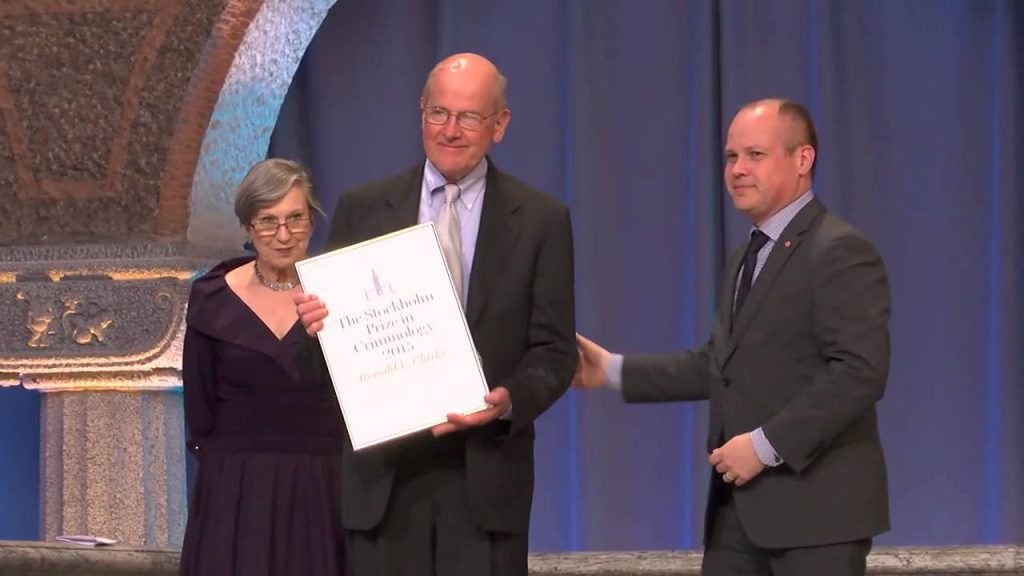
In 2015 I was happy to be able to attend – of my own volition, this time – when Ron and Patricia Mayhew received the Stockholm Prize in Criminology, and to meet (for one of only a handful of times) the brilliant scholars Derek Cornish and Marty Smith. For Marcus Felson’s festschrift published in 2015 in the Crime Science book series, Ron had submitted the same chapter title as Nick Tilley and I – ‘Target suitability and the crime drop’ – and so, but partly because of Ron’s emerging health problems, we co-authored it.
In the early 2020s, Ron was supportive of the notion of establishing an International Society of Crime Science, which is underway at the time of writing. Such a Society should nurture the work of researchers and practitioners focused on reducing crime opportunities. By 2025, Ron had been ill for some time and was no longer responding to emails, and in March Nick Tilley suggested that we edit a special journal issue as a tribute to ‘50 Years of Crime as Opportunity’ – the breakout 1976 study that pioneered much of Ron’s work on situational crime prevention. The special issue is also in preparation at the time of writing, co-edited with Gloria Laycock, Nancy La Vigne and Greg Breetzke, and I think we all knew it would in many ways be a tribute to Ron’s work more generally.
In my life and career so far, I’ve been fortunate to meet, work with and be influenced by many wonderful and talented people. On reflection, it seems a key aspect of Ron’s effectiveness in encouraging the work of colleagues was his use of situational inducement – by which I really mean he was thoughtful and generous – which is compatible with the situational prevention that he pioneered.
Graham Farrell, University of Leeds, 02 September 2025
Marcus Felson, PhD
Professor, Texas State University, San Marcos
“Ron Clarke has completely transformed my career as he has transformed crime opportunity research and theory. When I met Ron in 1980 he explained to me exactly how routine activity theory and situational crime prevention ideas were inseparable. He encouraged me to write CRIME AND EVERYDAY LIFE, and to develop those ideas. He offered dozens of important and serious suggestions for papers and chapters, many of which I followed. He introduced people doing common research or working on related ideas. He generated far more books and papers than he authored, despite the considerable number in the latter category. He is a master at studying the criminal event, and at finding the best natural experiments to illustrate basic principles. He is the greatest scholar, theorist, and researcher with whom I have ever worked.”
Additional Reflection:
“Ron has transformed my professional life in many ways. My email is to share a bit of the history in personal terms. The roots of ECCA emerged in the period 1980-1981. The Brantinghams got some funding to host a seminar series in Vancouver at Simon Fraser University, with a focus on environmental criminology. Indeed, the seminar started it all. The guests went one at a time, gave a talk or two, stayed at the Brantinghams’ home (at least I did), met with their students, etc. By the time they got to me the money was gone. I found out later they paid my way out of their own pockets. I was last. Ron was earlier. I think the others might have been George Rengert, Jim Lebeau, and some of the geographers who studied crime. While there, Paul told me three times to get to know Ron Clarke. A year later I was in London on holiday and rang up Ron. He invited me over to the Home Office and then arranged for Pat Mayhew to have us over for supper. As we all know, Ron knows how to arrange things. He knew my work on routine activities and we had long discussions about crime. He said something I never forgot: If crime opportunity explains how crime rates shot up, then reducing crime opportunity has to bring crime rates down. That was about 1980 or 1981. One of the important things to know is that Ron, the Brantinghams, Rengert, and the others were determined to cooperate and to build scientific work on crime. I don’t think any of us were formally trained in epidemiology, but I had taken some courses in demography and we all had a firm understanding of ‘exposure to risk.’ We all saw the offender’s personal and social traits as a distraction, putting us at odds with criminology, sociology, psychology, and society itself. We were all accustomed to being brushed aside, ignore, pummeled, accused, and the rest of the gamut. ECCA gave us a support system, an intellectual home, a way to trade ideas, a place to present, etc. The informal side of ECCA was as important as the formal. Ron played a central role, as we all know.
I have met both Ron’s parents, who were quite old then. I mention this because it gives us a window into Ron. Ron was a revolutionary dressed up in a suit and tie. He acted conventionally and his proper British demeanor concealed an improper disdain for much of conventional thought and research. He was an inside-the-establishment anti-establishmentarian. At the Home Office, he fostered situational research, to the consternation of the academic criminologists who wanted funding for new studies of old ideas that kept failing. He saw through them. He learned from his predecessor how to navigate the bureaucracy, but then he did something to poison his own well. He was aware of American research showing that hiring more police did not itself reduce crime. The Thatcher government was coming in with a promise to do just that. Ron replicated the American research and showed that enlarged policing did not do the job. The government did all it could to kill the report. Ron finagled somehow to get it public and to gain coverage in the press, knowing full well that was the end of his career in the Home Office. He did it anyway. He indeed ended there and found an opening as Dean of Temple University, then later Dean at Rutgers. He left Britain, but always kept a foot in the door there and flew in and out often enough.”
Joshua D. Freilich, PhD
Professor, John Jay College of Criminal Justice, CUNY
“Dr. Clarke’s research and ideas have influenced my career in many ways. My main research interest focuses on terrorism inside the United States. Similar to criminology though, most terrorism research has focused on understanding etiology — why terrorists commit their crime as opposed to opportunities and how terrorists successfully complete their strikes. This is surprising since this issue is so policy relevant and important. I have been influenced by Dr. Clarke’s book with Dr. Graeme Newman that applied SCP to terrorism and have sought to extend to their work in both the terrorism and criminology fields. I have always been struck by Dr. Clarke’s ability to convey his arguments in easy-to-understand language and his accessibility in always responding to queries and comments by providing insightful feedback.”
March 31, 2014
Martin Gill, PhD
Professor and Managing Director of Perpetuity Research, UK
“Ron Clarke has guided the development of not just crime prevention and crime science for which he is widely known, but also security management — the control of crime and other threats especially within organisations — and the influence has been both considerable and worldwide. An outstanding scholar and a humble and generous man. I am just one of many globally who has multiple reasons to be grateful for the support and encouragement along the way.”
April 14, 2014
Additional Reflection:
“Ron has helped me in many ways. Not long after I started my research consultancy in 2002 he met me to say that I could use any ideas he has produced without having to ask. In the event I hired him as a consultant on a number of projects and characteristically he over delivered. And what an insight to see a genius at work at close hand. In 2016 he contacted me and said that if I was in the US at any point he would like to meet up. As it happens, I was due to be in Washington a few months later. When I asked him how long we would need, he said a day. Now, what could the great Ron Clarke possibly want with me for a whole day? I will never forget it. It transpires he wanted to talk to me about the world of private security, its potential, its drawbacks, previous work I had done and his own thoughts. He told me a lot that day and of course I learned a lot. A scholar, an inspiration, always supportive and a very nice man indeed.”
Professor Martin Gill, Director Perpetuity Research & Consultancy International (PRCI) Ltd
Herman Goldstein & Mike Scott
Herman Goldstein: Professor Emeritus, University of Wisconsin Law School and Mike Scott: Professor, Center for Problem-Oriented Policing
“As a criminologist, Ron Clarke never set out to reform policing, yet his work in situational crime prevention has meshed so well with parallel work in problem-oriented policing that the effect has been to significantly improve the policing field, a true diffusion of benefits if we ever saw one.”
Quote from “Ron Clarke’s contribution to improving policing: A diffusion of benefits” by Michael S. Scott and Herman Goldstein, in The Reasoning Criminologist: Essays in Honour of Ronald V. Clarke, Eds. Nick Tilley and Graham Farrell. London and New York: Routledge. 2012.
March 28, 2014
Adam Graycar AM PhD, D.Litt, FASSA
Professor Emeritus, Public Policy and Stretton Institute, University of Adelaide
“Ron Clarke’s monumental legacy will be enduring. He shaped the discipline, inspired countless students, researchers and practitioners and was forever there for us all. When I was Dean of the School of Criminal Justice at Rutgers, he was always available for a helpful chat. Vale Ron.”
Elizabeth R. Groff, PhD
Associate Professor, Temple University, Philadelphia
“Rational choice perspective is the foundational theory for offender decision-making. The clear, concrete and detailed specification of rational choice perspective provided the basis for operationalizing the decision-making process of offender agents in my agent-based model of street robbery. It is a model for theory in the field of criminology.”
March 10, 2014
Rob T. Guerette, PhD
Associate Professor/Graduate Program Director, Florida International University
“Prof. Ron Clarke changed the way I view crime behavior and the world. As a young graduate student, I was imprisoned by the “offender propensity” mindset. My defining experience with Ron, as his student, research associate and him as my primary mentor, left me with a broader understanding of the importance of situational opportunities in crime which has been, and undoubtedly will be, the focus of my academic and research career.”
March 11, 2014
Additional Reflection:
“Ron Clarke was my mentor, a father figure, and a dear friend. Aside from my parents, he was among the most influential people in my life. I admired Ron for his calm, level-headed demeanor even in the most stressful situations, his uncanny ability to analyze complex issues with surgical precision, his remarkable efficiency, and his dry wit and humor.
I carry with me countless memories of our time together—some profound, others just fun. From career guidance to writing and publishing, Ron offered insights and words of wisdom that shaped my professional and personal growth. I will always treasure the time we nearly got into serious trouble in Mexico—Ron, ever the efficient one, decided to start a conversation about border patrol policy in a room full of human smugglers. And I’ll never forget the day my dog enthusiastically humped his leg in my backyard as he was speaking with his wife on the phone. Mortified, I tried to intervene, but Ron just chuckled and said with his characteristic wit, ‘It seems Rob’s dog is quite fond of me.’ Ron will always be remembered and missed.”
Alex Hirschfield, PhD
Professor of Criminology, Applied Criminology Centre, University of Huddersfield, UK
“As a geographer I always thought that criminology was largely a sociological discipline. That all changed when I learned about Professor Ron Clarke’s research on situational crime prevention. He opened up an entirely new world for me which has led to the pursuit of an immensely fulfilling and enjoyable career.”
March 25, 2014
Ross Homel, PhD
Foundation Professor of Criminology & Criminal Justice, Griffith University
“Ron Clarke is unique. Almost single-handedly he created the field of situational crime prevention, an incredibly active and practical area of criminological enquiry with untold benefits to communities and whole nations. Ron is irreplaceable since it is hard to imagine anyone else being willing or able to put in the work to analyze crime problems and develop prevention strategies in the way that Ron has done for many decades. But practical knowledge about how to effect real reductions in manifold forms of crime and harm in many, many contexts will be his enduring legacy.”
March 25, 2014
Mike Hough, PhD
Professor of Criminal Policy, Birkbeck, University of London
“Ron Clarke has made an enormous contribution to criminology by focusing attention on — previously ignored — situational factors in understanding offending. He has also helped the development of the careers of numerous criminologists, including myself — and I feel greatly indebted to him.”
March 7, 2014
Shane Johnson, PhD
Professor, University College London
“Professor Clarke’s work and encouragement have directly influenced my empirical and computational research on urban crime and its extension to extreme events (e.g. riots). He has motivated my research on (what were) new problems such as insurgency, maritime piracy and crime in developing countries. His advice has been invaluable.”
March 31, 2014
Marianne Junger, PhD
University of Twente, Netherlands
“I worked at the Ministry of Justice in the Netherlands and I am still involved in policy related research. What makes me proud of Ron Clarke’s work and the Crime Science theories, is that, based on this, we – the Crime Science researchers – are able to say to policy makers: we have a set of theoretical approaches that will help you solve problems. Indeed, Crime Science has been embraced by Dutch policymakers and integrated into all courses on the study of crime. I think this is true at the European level as well.”
April 1, 2014
George Kelling
Professor (Emeritus), Rutgers University
“Ronald Clarke is one of a very small number of criminologists whose work has reshaped the crime prevention paradigm. Situational crime prevention cuts across organizational boundaries and is as relevant for police as it is for business improvement districts. His work on the ground, working with real problems in real agencies, is a model for criminology and criminal justice professionals as well as students. He will be remembered as one of the criminologists of the late 20th early 21st century.”
April 8, 2014
David M. Kennedy
Professor/Director, Center for Crime Prevention and Control, John Jay College of Criminal Justice
“Ron Clarke modeled for all of us who came after what could be meant by an “applied criminology,” how to bring the highest levels of scholarly seriousness to that pursuit, and why that was in fact worth doing in practice. In so doing he fundamentally enriched and expanded our field.”
April 14, 2014
E.R. Kleemans, PhD
Professor (Serious and Organized Crime and Criminal Justice), VU School of Criminology, Faculty of Law, VU University, Amsterdam, The Netherlands
“Clarke’s work has inspired me to focus on crimes, next to criminals, and focus on preventive measures. Starting with predatory crime, Clarke has applied his ideas to scarcely researched crimes such as organized crimes, terrorism, and wildlife crime, thus eminently expanding the boundaries of thought about crime and crime prevention.”
March 31, 2014
Johannes Knutsson
Professor of Police Research, Norwegian Police University College
“Ever since I first come to know Ronald Clarke and his work in the late 1970s, he has been a great source of inspiration. His wholehearted dedication to the situational approach from its instigation, application and acceptance has been utterly important for its evolution. His insistence that research should have practical implications, enabling society to better be in a position to prevent crime is praiseworthy. Ronald Clarke is one of the few academics that has made a difference.”
March 24, 2014
Extended Reflection:
“Ron is no longer among us, and we miss him deeply. His contributions to academia and practice are immense. Besides being an exceptional academic, he was a generous and supporting person. I first met him in the mid-seventies at a conference in Sweden. That marked the beginning of a professional relationship that grew into a friendship. When he during a personal meeting in London a few years later explained the basic ideas of situational prevention, I was immediately enthusiastic. As a conventional criminology dissident, I was ready for this line of thinking.
Ron wanted to increase number of researchers that disseminated and evolved his philosophy. ECCA was one of his instruments, and from 1993 I became a regular attendant. When I organized the ECCA conference in Oslo in 1997, he was instrumental in recruiting leading experts relevant to policing, thus guaranteeing its success.
Since the nineties we met regularly at conferences worldwide. We found out that, besides situational crime prevention and problem-oriented policing, we had a passion for bird-photography. The digital camera revolution made possible photographing wildlife while carrying a camera equipped with a tele lens. That started our series of bird photo expeditions. In addition to Europe, we ended up in Australia, Malaysia, Africa and in South America. After a day in the field, we often entered lengthy discussions on the state of affairs in situational crime prevention and problem-oriented policing. These conversations resulted in four edited volumes of which three were published in his Crime Prevention Studies series. And in addition, I set up another ECCA meeting in Norway in 2012.
We acted according to the ‘catching the bird in flight’ principle — precisely in line with situational approach thinking. Ahead of an ECCA conference in Australia we did some birding and started to discuss why Problem Oriented Policing did not seem to catch on in the police. I suggested that we organized a small conference with leading experts who would present papers aimed for chapters in an edited volume. Ron thought the idea was excellent, but we lacked funding. Well, I said, I can probably convince the Norwegian National Police Commissioner to fund the conference. Less than two years later the book was published. Ron was instrumental in the entire process. Very generously the book was only in my name. It was his way of supporting me.
Another example — I had ended up in an agonizing research related conflict with the upper Swedish police bureaucracy, where they wanted to muzzle me. After our first day of bird photo’ing in our Uganda expedition, while enjoying the sun set over a beautiful landscape, he asked what had happened since last time we met. I told him the story. He responded that I had to write it up and give a speech at an ECCA conference for the benefit of young inexperienced researchers on the perils of applied police research. After some deliberation, I offered to organize next ECCA conference in Norway. Subsequent to my speech, I was persuaded to set up a small new conference aiming for another edited volume, this time about challenges of applied police research. Said and done.
Ron encouraged and supported me during my career, enabling me to make contributions to our field. It has been an honour and a privilege to collaborate with him and to be his friend.”
Johannes Knutsson, Professor emeritus, Norwegian Police University College
Jonathan M. Kremser, PhD
Assistant Professor, Kutztown University of Pennsylvania, USA
“Professor Clarke inspired me to think critically and analytically about research, which I am now able to pass along to my own students. I also incorporate his research in all of my classes. I owe him an eternal debt of gratitude for motivating me to succeed during times when I doubted myself.”
March 26, 2014
Tinus Kruger
Principal Researcher / Research Group Leader: Sustainable Human Settlements, Council for Scientific and Industrial Research (CSIR), South Africa
“Professor Clarke has inspired me and other South Africans not only through his excellent body of work, but also through his very personal encouragement and interest in us. His support of our work in a developing country context has motivated us to continue and to strive for excellence, while his humility and approachability remains an example to all of us.”
April 1, 2014
Leonid Lantsman
Program Officer, United States Department of State, Bureau of International Narcotics and Law Enforcement Affairs
“Dr. Clarke’s research on the relationship between crime and place has provided the foundational theoretical structure for my dissertation on understanding how seaports are used by criminal networks for illicit transfers. Without his trailblazing work, my work would lack the significant theoretical direction that his corpus of knowledge has provided for many scholars.”
March 31, 2014
Nancy La Vigne, PhD
Director, Justice Policy Center, The Urban Institute
“While many will attest to Ron’s scholarly contributions, which are extensive, I’d like to highlight the impact he’s had on the practitioner community. As a student and protégé of Ron’s who chose employment outside of academe, I’ve had dozens of opportunities to apply rational choice and Situational Crime Prevention (SCP) in partnerships with practitioners that have yielded real impacts on both knowledge development and crime reduction. Indeed, the utility of Ron’s deceptively simplistic yet tremendously powerful theories and their applications for ‘real world’ crime prevention are unparalleled.”
Extended Reflection:
“Ron Clarke was a caring and committed mentor to me and so many other students. He taught me to think and write clearly and critically and how to be creative in approaching research questions and analytic approaches. Ron is among a very small number of people in my professional life who have had tremendous and sustained influence on my work. Since contributing to Ron’s successful nomination to be honored with the Stockholm Prize in Criminology over ten years ago, I continued to learn and benefit from Ron’s brilliant contributions to Crime Science and his legacy carries forward in my commitment to keep Situational Crime Prevention, Crime Science, and an international focus alive and thriving at the school he once led as Dean.”
Nancy La Vigne, Dean, Rutgers School of Criminal Justice
Memorial Remarks for Ronald V. Clarke
Nancy La Vigne, Dean, Rutgers School of Criminal Justice
Good morning. Ron Clarke’s family asked me to speak about his remarkable professional life. A life that fundamentally transformed how we understand and prevent crime. It changed my own trajectory. And it transformed the paths of countless others.
I’m deeply honored to be here as Dean of the Rutgers School of Criminal Justice, the same position Ron held for over a decade. I was fortunate to be a doctoral student during his tenure as dean and to benefit from his guidance as my dissertation chair and beyond.
In preparing these remarks, I invited Ron’s colleagues, collaborators, and formers students to share their memories. The response was overwhelming. It’s a testament to the profound impact he had on so many lives. Their voices will help me tell Ron’s professional story today.
The Revolutionary Question
To fully grasp Ron’s influence, we need to start with a brief criminological history lesson. For decades, the field of criminology had been dominated by a singular question: “Why do people engage in deviant and unlawful acts?” Researchers focused on poverty. They studied family dysfunction and personality disorders. Essentially, they asked what was wrong with people who commit crime and what to do about them.
Then Ron came on the scene asking a radically different question: “How can we make crime harder to commit?” This change in perspective was revolutionary – and I’m not being hyperbolic. It shifted the perspective from a focus on the individual committing the crime to the crime event itself. And frankly, it wasn’t welcomed by mainstream criminology.
But that didn’t stop Ron from asking the question. In fact, he built an entire framework to answer it.
Rational Choice Perspective and Situational Crime Prevention
Ron’s answer first came in the form of rational choice perspective, which he developed in partnership with Derek Cornish, who sadly passed just a few weeks before Ron. The theory
was grounded in micro-economic principles – that people weigh the perceived costs and benefits of crime before committing it. In other words, crime isn’t just about likely offenders. It is shaped by opportunities and how likely offenders perceive them.
Importantly, Ron didn’t stop at theory. He developed the concept of situational crime prevention to apply the theory to concrete measures. He put forth that there are specific things you can do to remove or reduce crime opportunities. Increase the risk of apprehension. Make the offence harder to accomplish. Reduce the rewards associated with the violation. If you do these things, and others like them, you can prevent crime without changing the individual at all.
Ron showed us practical applications of situational crime prevention across a wide array of offences. And he and others demonstrated that they worked. Installing better lighting reduces street crime. Steering wheel locks reduce car theft. Removing phone booths from subway stations reduces vandalism. I could go on and on.
Groundbreaking Government Research
This practical approach defined Ron’s entire career, beginning with his groundbreaking work in government research in the UK.
During his sixteen years at the Home Office Research Unit, Ron built the intellectual foundation for modern crime prevention policy. His efforts led to Home Office Circular 8/84 – a decidedly mundane title for a nonetheless impactful policy. This circular promoted a multi-agency approach to crime reduction, shifting the focus away from solely a police response towards situational crime prevention and community-based initiatives.
Ron was central to establishing the British Crime Survey in 1981, what’s now called the Crime Survey for England and Wales. This survey revolutionized our understanding of crime patterns and trends, especially because it shed light on victimizations that are not necessarily reported to the police.
But Ron’s inquisitive nature sometimes came at personal cost. Ron conducted research in the UK showing that simply hiring more police – a key strategy of the Thatcher administration at the time – didn’t reduce crime. Ron ensured that the research became public despite knowing it would end his Home Office career. Nonetheless, he chose intellectual integrity over institutional comfort.
Global Academic Influence
When Ron moved the US and into academia, his influence only grew.
During his tenure at Rutgers, he continued to expand his ideas globally. He played a central role in founding the Environmental Criminology and Crime Analysis network, a safe harbor for people like us who were interested in studying what’s now known as “crime science.” He launched Crime Prevention Studies as founding editor. He authored or co-authored more than 300 books, monographs, and papers. And importantly, he had a heavy hand in hundreds of others but generously insisted that the authorship go solely to his collaborators, who were often proteges, in the interests of helping them establish their careers. Ron’s scholarly achievements earned him the Stockholm Prize, criminology’s highest honor, which he shared with Pat Mayhew in 2013.
Ron also forged a close partnership with the late Herman Goldstein. Together, they applied situational crime prevention principles to Goldstein’s evidence-based problem-oriented policing framework.
Ron’s love of birds and wildlife inspired him to extend his vision even further. As Gohar Petrossian shared, major conservation organizations have embraced Ron’s ideas. Wildlife Conservation Society and Flora and Fauna International have embedded Ron’s principles into their strategic plans. These concepts now inform the fight against wildlife trafficking throughout the world.
The Person Behind the Professional
So now we know Ron’s legacy as a scholar, but what was he like as a colleague, a professor, a mentor?
Marcus Felson called him “a revolutionary dressed up in a suit and tie.” An “inside-the- establishment anti-establishmentarian.” Someone who challenged conventional thinking. But he didn’t do it with loud proclamation. He did it with quiet conviction and rigorous evidence.
Jerry Ratcliffe described Ron as having “a refreshing disdain for most of the nonsense that passes for much modern sociology and criminology around crime.”
Ron simply had no patience for certain arguments. Some people argued that crime could only be reduced by wholesale reductions in poverty. Ron knew that targeted prevention
could achieve much more. And it could do so “in a fraction of the time, at a fraction of the cost.”
Andrew Lemieux described Ron as “a great man with a mind to match. He challenged the status quo and dug in his heels when he knew he was right…which was most of the time.”
Exceptional Mentorship
As revolutionary as Ron was in his thinking, he was equally remarkable as a mentor.
Ron’s reserved British demeanor might have suggested a formal, distant professor. But those of us who knew him understood otherwise. I remember my doctoral cohort at Rutgers devising a scheme to coax Ron and Sheelagh onto the dance floor at the school’s annual holiday party. Our song of choice? Jane’s Addiction’s “Got Caught Stealing.” And allow me to say, those two really cut up the rug! We later referred to that as the “dean dance” and I believe the tradition carried on for several years.
Frivolity aside, Ron’s commitment as a mentor ran deep. Gloria Laycock’s tribute reveals how Ron quietly orchestrated opportunities for others to flourish. He suggested she join the Home Office Research Unit and he supported her in the establishment of the UCL Jill Dando Institute of Security and Crime Science.
Lorraine Mazerolle described how Ron picked her up at the airport as a first-year PhD student traveling from Adelaide to Newark. He and Sheelagh opened their home to her, as well as to her parents when visiting from Australia.
Mangai Natarajan shared how Ron assigned her an exam focused on environmental criminology topics. She did so well on it that it formed the basis of a Routledge publication and book, which no doubt spurred her academic career while spreading the gospel of opportunity theories of crime.
Johannes Knutson described his long professional relationship and friendship with Ron that combined a shared passion for bird photography with a strategic partnership that brought situational crime prevention to new audiences, like the Norwegian National Police.
Anthony Braga shared how Ron contacted him regularly to check in on his dissertation progress after he left Rutgers for Harvard. Anthony reflected that he would probably still be working on the degree if it wasn’t for Ron’s compassionate accountability. I heard similar stories from Justin Ready and Will Moreto. And I experienced it myself.
Ron didn’t just transform criminology. He transformed criminologists. At least fifteen former Home Office Research Unit colleagues went on to senior academic positions, making significant contributions to criminology and justice policy.
As David Weisburd observed, Ron influenced “scores and perhaps hundreds of scholars.” These scholars now carry forward both Ron’s ideas and his example of rigorous, practical scholarship.
The impact of Ron’s mentorship extended far beyond individual careers.
Ron created what Pat Mayhew and Mike Hough describe as “an occupational ethos.” This ethos emphasized methodological rigor and intellectual independence. It was coupled with real engagement with policy issues.
And despite his enormous influence, Ron remained remarkably humble. As Richard Wortley noted, “for Ron, it was all about the work.”
Ron’s Living Legacy
And this brings me back to where I began.
Standing here today as Dean of the school Ron once led with such distinction, I’m reminded that his influence continues in ways both profound and personal. His belief in the power of applied scholarship, his commitment to mentoring the next generation, his understanding that academic work should serve society—these principles continue to guide a whole cadre of applied researchers who in turn have passed on his ethos to others.
In doing so, Ron created what Paul Ekblom, borrowing from Christopher Wren’s epitaph, called his monument: “If you seek his monument, look around you.” We see it in safer communities. We see it in wildlife protection efforts. And we see it in the careers of countless researchers and practitioners.
Ron Clarke was, as Richard Wortley noted, “the most important criminologist of the 20th century.” His ideas will endure. His influence will continue to spread. And those of us who were privileged to learn from him will carry forward his vision of scholarship that makes a difference.
Thank you, Ron, for everything you gave us. Rest in peace.
Anita Lavorgna, PhD
University of Trento, Italy
“I just obtained my PhD from the University of Trento, Italy. I will be a lecturer at the University of Wolverhampton starting in September 2014. I will forever be thankful to Ronald Clarke. He is a real role model and mentor. His enthusiasm and love for teaching and research are contagious, his kindness and readiness to help inspiring.”
April 14, 2014
Extended Reflection:
“When I first met Ronald Clarke, I was seriously considering quitting my PhD. He made me feel seen, as a researcher but – first of all – as a person. I remember that bagel he offered me for lunch when I first arrived as a visiting researcher at Rutgers without knowing anyone there, the chats on my theoretical and methodological framework in the library, and how I loved his teaching style while following some of his classes. He encouraged me to meet some great colleagues, to go to conferences, to write, and to write on wildlife trafficking. To find my own place. He was a brilliant mind, a great writer, a mentor to many. But he was also one of the more gentle human beings I ever met. ‘Academia can be different, I want to be like Ron!’ is still my mantra, when things get tough, when I do my best to make my students feel seen. I will cherish his emails, and the memory of his kindness and his genuine curiosity as the treasure they are. Thank you for everything, Dr Clarke.”
Anita Lavorgna, University of Bologna
Gloria Laycock
“Ron has also left a legacy of a different sort for British criminology. During his time at HORU/RPU he was central in developing an occupational ethos that emphasised methodological rigour and intellectual independence coupled with real engagement with policy issues. In hindsight, we feel that this ethos prepared several of us for careers in academia when the role of government researchers became less convivial — in the period from the mid-1990s onward. There was a significant diaspora of RPU staff, to a range of largely academic posts. We can count at least 15 of us who have had — or still occupy — senior academic positions from which they have made significant contributions to both criminology and justice policy.”
Extended Reflection:
“Ron had an incredible influence on my career and hence on my life. His PhD on absconding from approved schools tested the extent to which personality characteristics were predictive of absconding. They weren’t. So, when I did my PhD on absconding from borstals in the late 1960s, I started from where Ron left off. Borstal boys with previous convictions for burglary (they could break out as well as break in) and car theft (they could steal a car and drive away from the remote institutions) were more at risk of absconding. But if you kept them in a secure unit for a couple of weeks on arrival, they settled down and served their sentence. This was an example of what Ron later called situational crime prevention.
After I finished my PhD, he suggested that I move to the Home Office Research Unit; so I did. Then he suggested I move to the Crime Prevention Unit (CPU); so I did. And he supported the publication of the CPU papers. And when I thought the police needed a Home Office Police Research Group, he supported that, and it happened. He helped me on my fellowship at NIJ, and suggested that I apply for the Jill Dando job in 2001; so I did. In the early years he supported the JDI hugely, teaching pro bono for several periods until we were established. Then when I was offered a second two-year stint in the UAE, he told me no, it was time to come home to UCL. I came home.
Throughout all that period he continued with his extraordinary publication record, including the Crime Prevention Studies book series (to which he invited me to contribute). And of course, he was central to the creation and maintenance of ECCA.
I remember one of the few times I saw Ron really excited. He wanted me to come into his office to see something on his computer. I rushed in not knowing what it could be. It was a photograph of a parrot. I was uncharacteristically speechless.
I have had a wonderful life and career and worked in an important and fascinating field of policy and practice. It would have been very different without the influence of Ron Clarke.
Thank you, Ron, and rest in peace.”
Gloria Laycock, Pat Mayhew, Mike Hough
Professor Ron Clarke – an appreciation
Our colleague Ron Clarke died on 28 May 2025 in a nursing home in New Jersey at the age of 84. His ideas have been enormously influential both on criminal policy and on criminology, both within Britain and internationally. We suspect, however, that many members of the BSC will be insufficiently aware of his impact, and this note is intended as a corrective, describing his contribution to criminal justice policy and theory, and the very significant way that he shaped the careers of many of his research colleagues.
His career in the UK can be summarised in brief. He began as a Research Officer at Kingswood Approved School near Bristol in 1964. In 1968, by which time he had completed his doctorate, he joined the Home Office Research Unit (HORU), later rebadged as the Research and Planning Unit (RPU). By the early 1970s he had become Deputy Director, and by 1983 he had been appointed as Director. In 1984 he resigned, moving to the US to take up a chair at Temple University, Philadelphia. In 1987 he moved to the School of Criminal Justice at Rutgers State University, New Jersey, as Dean and Distinguished Professor, a post he held until 1998. He continued at Rutgers as an (active) Emeritus Professor until his death.
Over his sixteen years at the Home Office, he laid the intellectual foundations of his future work. He clearly had sympathy with the view prevalent among many academics in the late 1970s that rehabilitative or deterrent strategies had little impact on people’s propensity to commit crime, but in contrast to the doctrine that ‘nothing works’ he was clear that modifying the opportunity structures within which offending took place could have a marked impact on crime rates. He and his team at the Home Office Research Unit mounted a series of research projects which demonstrated ways in which crime was shaped by environmental factors. The 1975 report Crime as Opportunity gathered several of these studies together to make a persuasive case for what was known as ‘physical’ prevention or what became known as ‘situational’ crime prevention (SCP). Ron continued to promote SCP, which provided the theoretical underpinnings of the – really significant – Home Office Circular 8/84. This, for the first time, promoted a multi-agency approach to crime prevention, including the need for local authorities to play their role in designing out crime. Over the next ten years SCP became accepted as one of the core pillars of UK crime prevention policy. He also played a central role in initiating the British Crime Survey in 1981. This survey (now the Crime Survey for England and Wales) revolutionised knowledge about the nature of crime and crime trends.
After Ron’s departure for the US, SCP became firmly embedded in the work of UK local community safety partnerships, and contributed to the development of problem-oriented policing. The Home Office Crime Reduction Programme, running from 1999-2002, was infused with SCP thinking. And within academic criminology, it has become increasingly accepted that the changes in the structure of criminal opportunities provide the key explanation for the crime drop that began in 1995 – centring largely on ‘tighter’ security. In the US, Ron continued to promote SCP and environmental criminology. He progressively developed his thinking on SCP, and he was a central figure in establishing the highly influential Environmental Criminology and Crime Analysis (ECCA) network.
Most policy researchers would be pleased to have had such an impact on both policy and academic thinking, but our sense is that Ron had larger ambitions for SCP, which he felt were never met. In discussions that we had with Ron, he took a more pessimistic view: that take-up of his ideas has been partial and limited. We have argued elsewhere (Mayhew and Hough, 2012), that this stubborn pessimism is perhaps a pointer to the reasons for his success. The pessimism reflects ambitions for SCP that were very high indeed – and are arguably unachievable. If he had simply promoted SCP as one of several strategies for tackling crime – best deployed in combination with social prevention and rehabilitative work with offenders – few people would have taken issue with his ideas. But probably few would have taken much notice of them, either.
Ron has also left a legacy of a different sort for British criminology. During his time at HORU/RPU he was central in developing an occupational ethos that emphasised methodological rigour and intellectual independence coupled with real engagement with policy issues. In hindsight, we feel that this ethos prepared several of us for careers in academia when the role of government researchers became less convivial – in the period from the mid-1990s onward. There was a significant diaspora of RPU staff, to a range of largely academic posts. We can count at least 15 of us who have had – or still occupy – senior academic positions from which they have made significant contributions to both criminology and justice policy.
Ron’s leadership style was never charismatic, but working with him was exciting and rewarding, as we felt part of a significant enterprise. He was immensely encouraging and supportive, and he created opportunities for us to develop our talents. The authors of this note developed a variety of professional interests. One of us (Gloria Laycock) has continued to develop and elaborate SCP thinking, under the banner of crime science. Pat Mayhew shared with Ron the Stockholm Criminology Prize, for their joint work on SCP, and Pat has continued to make a significant contribution to national and international crime surveys. Mike Hough has also retained a clear policy focus in his research, even if his recent contributions to understanding of the processes leading to normative compliance would probably have earned a slight frown from Ron. But we all feel a debt a gratitude to him, and have little doubt that others in the UK, US and further afield will feel the same way.
Mayhew, P.M., Clarke, R.V.G, Sturman, A. and Hough, J.M. (1976). Crime as Opportunity. Home Office Research Study No. 34. London: HMSO.
Mayhew, P. and Hough, M. (2011) “Situational crime prevention: the Home Office origins” in Nick Tilley and Graham Farrell (Eds) The Reasoning Criminologist: Essays in Honour of Ronald V. Clarke: Abingdon: Taylor and Francis.
Antony C. Leberatto, PhD
Student, Rutgers University-Newark
“Working with Dr. Clarke is an absolute pleasure because he is open to hearing new ideas and continues to be enthralled in the process of learning. He helps you embrace that there is still much work to do in a humble, supportive and encouraging manner.”
April 1, 2015
Benoit Leclerc, PhD
Senior Lecturer, Griffiths University Australia
“Ron Clarke has been the main driving and passionate force behind the situational prevention perspective since its beginning. The work he accomplished and how he disseminated benefits of this work all over the world will never be matched in the future. In addition to being a true pioneer in the field of criminology, he has been, and continues to be a fantastic mentor for young scholars.”
March 7, 2014
Andrew Lemieux, PhD
Researcher, Netherlands Institute for the Study of Crime and Law Enforcement
“Ron’s encouragement to study wildlife crime from a criminological perspective has led me to investigate an exceedingly complex problem with real world implications. Indeed, my work with anti-poaching teams in Uganda finds its roots in an elephant poaching study I did with Ron in graduate school.”
March 12, 2014
Additional Reflection:
“Ron’s impact on crime prevention globally was undeniable. More importantly, the mentorship he provided to so many of us has ensured his legacy will live on for generations to come. He was a great man with a mind to match. He challenged the status quo and dug his heels in when he knew he was right…which was most of the time. It was an honor to work with him and help bring his vision of wildlife crime prevention to life. Rest in peace Ron.”
Fernando Miró Llinares
Catedrático de Derecho penal y Criminología, Director del Centro CRÍMINA para el estudio y prevención de la delincuencia, Universidad Miguel Hernández
“I’m truly saddened by the news of Ron Clarke’s passing. We’ve lost a giant — not only in the scientific study of crime, but in the way we understand and do criminology. Ron was an exceptional social scientist, and he gave us so much. He changed our discipline forever and touched the lives and minds of many of us. His legacy — through ECCA and so many other contributions — will stay with us always. To all of you who feel the pain of this loss today, I send a warm hug. And let’s also take a moment to feel grateful: for having known him, for having learned from him, and for the chance to share time and ideas with someone so inspiring.”
Lin Liu
“Sorry to hear the sad news. I met Ron a few times during some of the early ECCA meetings. I remember him as a very friendly and kind person. When I hosted ECCA 2019 in Guangzhou, Ron emailed me multiple times to ensure that the award plaque was properly issued. I admired Ron’s attention to the details, the true character of a top scholar. At the moment, a group of scholars working on crime research in China are mourning passing of Ron.”
Tamara D. Madensen, PhD
Associate Professor, Director, Crowd Management Research Council, University of Nevada, Las Vegas
“Dr. Clarke changed my way of thinking about crime. His deeply analytical and practical approach showed me how we can change the world bit by bit, by focusing in very specific problems. His work inspired a decisive shift in the direction of my research interests and my career.”
March 27, 2014
Nerea Marteache, PhD
Assistant Professor, California State University San Bernardino
“Dr. Clarke changed my way of thinking about crime. His deeply analytical and practical approach showed me how we can change the world bit by bit, by focusing in very specific problems. His work inspired a decisive shift in the direction of my research interests and my career.”
March 27, 2014
Michael G. Maxfield, PhD
Professor, John Jay College
“Clarke created the British Crime Survey (BCS), which redefined crime surveys to become a platform for research and policy development. As one example, repeat victimization was operationalized with the BCS, a concept dismissed as series victimization in the NCVS. Clarke re-invented crime prevention, again linking research and policy.”
March 31, 2014
Pat Mayhew, PhD
Retired, Home Office, England
“I worked with Ron for over 30 years, both when he was in the UK and the USA. He was inspirational, inventive, incisive, insightful — and occasionally an academic curmudgeon. I owe him for most of my academic and professional development as well as for my commitment to policy-based criminology.”
March 27, 2014
Lorraine Mazerolle, PhD
Professor, University of Queensland, Australia
“Ron Clarke recruited me from Australia to the PhD program at Rutgers in 1990. He was the Chair of my PhD committee. Ron’s theoretical and policy ideas fundamentally shaped my early research agenda, setting the career foundations for me to advance knowledge on the role of police in reducing crime and sharing responsibility for crime prevention.”
March 25, 2014
Extended Reflection:
“My sincere condolences on the passing of Ron. As you know, Ron was so very kind to me (and to my parents) when I moved from Adelaide (South Australia) to New Jersey to do my Masters and PhD at Rutgers in 1990. I had met Ron in Adelaide when he came to the National Policing Research Unit in 1989 as a Visiting Research Fellow. At the time, he was working on a bunch of studies with police across Southern Australia on applying situational crime prevention measures to deal with robberies. He suggested I apply to do my PhD at Rutgers starting in the fall of 1990, offering to give me an office on the 13th floor of the SI Newhouse Center where, he told me, I could see the Statue of Liberty (you could….but just the tip of the flame). As a 25 year old, an office with a view of NYC sounded like a pretty good deal — so I packed myself up and headed to Newark, New Jersey. Ron picked me up at the airport and he and Sheilagh very kindly let me stay with them in their Milburn home when I first arrived. I was always so grateful for the pastoral care that Ron and Sheilagh gave to me, not just when I first arrived, but during my entire ten years of studying, living and working at different universities whilst in the US. They had my parents over for dinner when they visited and Ron always made sure I was tracking OK, finding my way in a new country. Ron was like that: offering a regular cuppa tea and a gentle chat to see how things were going. His intellectual influence on me and so many of his former students is enormous. I am grateful for him being my dissertation chair, mentor and friend. I will miss him dearly.”
Lorraine Mazerolle, AC Emeritus Professor of Criminology
Robert McCrie
“In 1988, Charles H. (Sandy) Davidson, staff director of the ASIS (formerly the American Society for Industrial Security) Foundation, stopped me at the annual ASIS Seminar and Exhibits and invited me for a drink. He opined that security was becoming ‘a management science’ and that an impressive Body of Knowledge was being amassed by James D. Calder of the University of Texas at San Antonio. According to Sandy, the Foundation was determined to support a scholarly, vetted international journal on protection of assets from loss. Butterworth Publishers had been lined up to handle the mechanics. It would be named Security Journal and they wanted me to edit it. With true reluctance, I agreed. An Editorial Advisory Board of 27 people was convened (some of whom remain on it today) and our first issue was published in 1989.
The initial two issues were easy to produce as a wide variety of academics had completed substantive articles with nowhere to publish them. The timing was right. Then the flow of usable submissions began to trickle. Honestly, I was becoming panicked. In the spring of 1990, my phone rang and I heard the dulcet voice of Ronald V. Clarke. (He was not on our board and I had never heard of him before.) Ron stated that he was at Rutgers School of Criminal Justice and an advocate of situational crime prevention. I didn’t know what that was, but it sounded good. He had collected and vetted a number of publishable research papers. Would we be interested in a special issue with them? Sandy Davidson and I met Ron at my club in New York to discuss the project. We agree to Ron’s terms and he to ours. This began a years-long relationship that produced several special editions over the following years, all supporting the research basis on reducing risk.
Ron Clarke saved Security Journal. Researchers who were to become eminent (if they weren’t already) graced our publication. A few include: the Brantinghams, Marcus Felson, George Kelling, Gloria Laycock, Ken Pease, Ron himself, and so many others. Ron’s work–and that of his collaborators–established what is today accepted as the philosophical basis of crime reduction and order maintenance. His encomia included the Stockholm Prize in Criminology and an honorary doctor of science, honoris causa, from John Jay College of Criminal Justice. It was a life well lived, indeed, for himself, his family, and all of us.”
Gorazd Mesko, PhD
Professor of Criminology, Dean of the Faculty of Criminal Justice and Security, University of Maribor, Slovenia
“Professor Ronald Clarke’s contributions in the field of Environmental Criminology, especially the Rational Choice Theory and Situational Crime Prevention are enormous. His research and discussions on diverse aspects of situational crime prevention have significantly contributed to the development of academic research and practical application of situational crime prevention measures globally. Professor Clarke’s work has also had a huge impact on the development of crime science and policing worldwide.”
April 4, 2014
Sunniva Meyer, PhD
Research Officer, Institute of Transport Economics, Norway
“After starting my PhD on game theory and terrorism, I wanted to understand how to counter terrorism in practice. Then I discovered Clarke’s authorship on employing SCP to terrorism. Inspired by him, I today employ different crime science methods on everything from terrorism to unpleasant incidents in public space. I thank Clarke for showing me how researchers can support security practitioners in the field.”
March 25, 2014
William Moreto, PhD
Assistant Professor, University of Central Florida
“To many, Professor Clarke is known as the consummate scholar whose innovative, yet pragmatic approach to understanding crime was instrumental in the development of environmental criminology, crime science, and situational crime prevention. To a select few, he is also known for his passion and devotion as a mentor. His dedication to his students is unrivaled, and his place within the discipline is undeniable.”
March 24, 2014
Extended Reflection:
“Professor Ron Clarke was one of the reasons why I decided to attend Rutgers (the other reason being his good friend and colleague, Marcus Felson). We spent countless hours discussing the current state of criminological, criminal justice, and crime science research and avenues for potential research topics. While he was known to many for his legendary career, I knew him as a dedicated, caring, and trustworthy mentor. He instilled confidence to examine topics that may be viewed as niche (or at least areas that may not have generated much attention at the time) but were fascinating to study. He also encouraged me to remain the person I was, even when the pressures of academia would suggest otherwise. In a career that tends to center on the ideas of ‘publish or perish’, ‘fundable research’, and ‘prestige journals’, Professor Clarke guided and grounded my approach to focus on applied, translational, impactful, and meaningful research. He taught me the importance of reaching different audiences with my work, and to ensure that such work could be communicated in a manner that would be understood. He encouraged me to trust the process, rather than simply focus on outcomes, and to embrace being a scholar. Notably, the pride he had for his former students was evident in how frequently he would refer to their work when he guided his current students. That sense of pride is clearly reciprocated from his students as recollections of great moments and unforgettable lessons are often articulated amongst his students. I was fortunate to be able to get to know Professor Clarke on a personal level as well. I will treasure the conversations we had about his family, his career, and his interests (outside of understanding and preventing crime, of course). I will reflect fondly on being able to spend time with him and Sheelagh in the ‘lighthouse home’ in Sanibel, enjoying a ‘proper English breakfast’ in their Wimbledon cottage, and hearing stories about Marcus in their Milburn home. Finally, I will remember Professor Clarke for his humor. We shared many laughs, although to this day, I still don’t know if he was joking or not on some occasions. I suppose that was the brilliance of his wit. Professor Clarke was an exceptional scholar, mentor, and person. I will miss him.”
Will Moreto, PhD, Associate Professor and Graduate Programs Director, Department of Criminal Justice, University of Central Florida, Rutgers University (Class of 2013)
Frank Morgan, PhD
Director, Crime Research Centre, University of Western Australia
“Ron Clarke’s pioneering contributions to criminology and crime prevention have spanned over 35 years and become increasingly influential. His rational choice approach generates a genuine theory of prevention and now dominates the thinking of those with responsibilities for crime prevention. It is backed up with ever tightening conceptual refinement in academic theorising.”
March 26, 2014
Mangai Natarajan, PhD
Professor, John Jay College of Criminal Justice, CUNY, USA
“Modifying crime opportunity structures can result in immediate reductions in crime. Ron Clarke’s practical approach to prevention has been applied, not just to street crimes in the UK or US, but also to various crimes in developing economies such as India. These crimes include burn and acid attacks on women and tiger poaching.”
March 22, 2014
Extended Reflection:
“Prof. Clarke was a remarkable mentor and an exceptional friend to me. I am privileged, like many students at Rutgers, to have received my PhD degree certificate from him during his tenure as Dean at the graduation podium. This heartbreaking news saddens me, yet I find solace in the enduring memories.
One is about planning and preparing the nomination for the Stockholm Prize. To enhance the nomination package, I reached out to many of Prof. Clarke’s colleagues, students, and collaborators, asking them to share their thoughts on his legacy. Attached is a compilation of those statements, which was gathered ten years ago. New contributors are welcome to add their insights to the compendium, and those who have previously contributed may also include additional statements. Once Pat and Paul wanted to publish it. Nancy might consider using this compilation as a foundation for highlighting Prof. Clarke’s legacy, though there is no obligation to do so.
Professor Clarke assigned me an exam/exercise focused on ECCA topics. When I received an invitation from Routledge, I was able to compile my assignment in the form of ‘Crime Opportunity Theories: Routine Activity, Rational Choice, and Their Variants’ (The Library of Essays in Theoretical Criminology, 1st Edition, 2011) and an eBook published by Routledge in 2017. To this day, I take great pride in this achievement as it contributed to my ECCA ‘A’ grade from Prof. Clarke. I’m not sure how many people knew about this publication.
After writing this long note, I now feel lighter and ready to move on (first go to sleep-almost 2 am) with the knowledge and skills that Professor Clarke has given me. I am grateful to him for life. The loss is immense to the Criminology/Crime Science, students, colleagues, collaborators, friends and family.”
Mangai Natarajan, PhD, Professor, Department of Criminal Justice, John Jay College of Criminal Justice, The City University of New York
Graeme R. Newman, PhD
Distinguished Teaching Professor School of Criminal Justice, University at Albany
“No criminologist, alive or dead, has shown as conclusively as Clarke, that crime can be reduced substantially with evidence-driven interventions. His superb research has spawned a generation of scholars who now apply his work to the fields of public security, cyber crime, counterterrorism, public health, and the entirely new field of wildlife crime.”
March 12, 2014
Extended Reflection:
“My lifelong friendship with Ron Clarke began when, on leave from the U.K. Home Office, he joined the University at Albany School of Criminal Justice as a visiting professor in the early 1980s. [This would amuse him. Actually, I just checked with my constant companion, ChatGPT, who reminded me that Ron was at UAlbany in 1981–1982.] His kids were a little older than mine, but that didn’t matter. Our families had much in common—or so it seemed. My wife and I are (were, but still feel like) Aussies, and thus, by default, subjects of Her Majesty. From Ron’s English perspective, that meant we shared some sense of ‘Englishness.’ Although, I suspect he viewed me as a slightly lesser subject of the Queen, having been born in Australia. Ron, quintessentially English, was born in England, went to boarding school (of course), and yet spent much of his childhood in deepest, darkest Africa. It irked him no end when I produced my British passport—earned only because my father, born in London, had migrated to Australia as a toddler.
Our academic and research collaboration began with a phone call from him during his time at Rutgers School of Criminal Justice. Would I help him write a report for the British Home Office on internet crime prevention—or something like that? Ron, though long departed from the Home Office, still maintained close ties with colleagues there and in academia. Apparently, there was a crisis: his friend at the Home Office had unexpectedly secured a sizeable grant to produce a report on online crime, but only a couple of weeks remained before the funds expired. Would I join him in this mad venture? I protested that I knew very little about the internet—or at least, about cybercrime. ‘Rubbish!’ he replied. ‘Of course you can do it.’ The money was good, my kids were starting college, and how could I say no?
We delivered the report to the Home Office on time (though I’m still not sure how we managed it), collected our payment, and his colleague was hugely relieved. Even better, out of that sprint came our book Superhighway Robbery. From then on, I was hooked on his simple yet brilliantly insightful theory of situational crime prevention—a framework that proved both elegant and profoundly complex, its influence reaching far beyond criminology and policing into fields like terrorism. Our second book together, Outsmarting the Terrorists, grew out of that work and was written while we were in Australia—where Ron also pursued his other great passion: bird photography. Around the house where we stayed, he identified some 75 different species.
But I’ll confess there were limits to my patience. Trailing him through the Australian bush while he lugged a camera with a massive telephoto lens—he excitedly calling out every sighting—left me bored out of my mind. Others (including my companion ChatGPT) have noted how the dedication and persistence of birdwatchers mirror the skills of great scientists.
What struck me most, though, was how Ron, despite his extraordinary achievements—his publications, awards, and the lasting impact of his students’ work—sometimes seemed to feel isolated, not fully embraced by mainstream criminology. To me, it seemed he lived for his research, and that was enough. I say this as someone who saw a lot of him during his seven years as Dean of Rutgers School of Criminal Justice. We often met for lunch at the diner around the corner. I marveled at how calmly he handled the pressures of administration—always careful, deliberate, and never appearing harried. Perhaps those working under him saw another side. But to me, even as Dean, he was still the Ron I knew: thoughtful, composed, and quietly brilliant.”
Yuxuan Nie, PhD
Assistant Professor, Yunnan University, China
“Dr. Clarke was the chair of my PhD committee. I was greatly benefited from his mentorship, which helped understand further criminological theories and practices.”
March 26, 2014
Ken Pease, PhD
Visiting Professor of Crime Science, University College London
“Ron Clarke is the doyen of situational crime prevention, a tradition within criminology which deserves recognition commensurate with its importance and impact. The range of Ron’s work, from trafficking in endangered species through violence at soccer grounds to cybercrime is perhaps unique.”
March 25, 2014
Gohar A. Petrossian, PhD
Assistant Professor, John Jay College of Criminal Justice
“Dr. Clarke has mentored me throughout graduate school and now continues to work with me on various research projects. His impact on my intellectual growth has been immeasurable, and his ideas and theories continue to serve as guiding principles in my own research.”
March 8, 2014
Extended Reflection:
“It is truly devastating to hear the news about Dr. Clarke’s passing. When I first met him in my Foundations of Scholarship class at Rutgers, I could have never fathomed that he would change the trajectory of my career in such a fundamental way. His guidance throughout my studies at Rutgers and his mentorship for so many years after having only confirmed this profound sense of responsibility I have to continue his legacy in the wildlife crime research realm. I was honored (could have never imagined he would ask me!) to put together the Wildlife Crime Panel at Stockholm Criminology Conference the year he was getting his award. I was humbled to have received one of the photos of a petrel he took from a longline during one of his trips to Australia when our co-authored paper on illegal longline fishing and albatross/petrel extinction risk got published. The photo was printed on glass in Germany, he told me! It is through these small but deeply meaningful gestures that he planted his passion for wildlife into me.
Two years ago I spoke with him on the phone to let him know about how major conservation organizations, such as Wildlife Conservation Society and Flora and Fauna International have embedded crime science and SCP into their strategic plans for fighting illegal wildlife trade, and, how, as a result, I have travelled to Kyrgyzstan, Peru, Panama, Colombia and many other corners of the world to train eco-police on this. He was thrilled, thrilled to know that his vision has penetrated the minds of conservation scientists ready to fight this crime. He was thrilled, but I am sure not surprised.
I will miss him tremendously, but his legacy will live through me, as I will make sure wildlife crime research and the application of crime science and SCP to fight this crime remain mainstream for as long as I can live as a scholar.”
Stephen F. Pires, PhD
Assistant Professor, Florida International University
“As a PhD student at Rutgers University, I had the privilege in working with Dr. Clarke on multiple projects related to the illegal parrot trade. I learned many things from him, but what stood out amongst everything was his incredible work ethic and devotion to the field of crime science. I simply would not be where I am without the guidance and mentorship that Dr. Ron Clarke provided me.”
March 25, 2014
Extended Reflection:
“While the world knew Dr. Ronald Clarke as a pioneering figure in crime science and environmental criminology, I knew him first and foremost as a mentor. Before working with him, I had no idea how prolific an author he was, nor how influential he was within our field. Dr. Clarke was in his mid-to-late 60s by the time I was a PhD student at Rutgers University—an age, I imagined, when faculty were practicing their chips and putts on the greens while getting ready for retirement. Not my mentor! He was among the most productive scholars in the department and chaired more students than anyone else, and I count myself incredibly fortunate to be among them.
I vividly remember working on our first manuscript together. We went through seven drafts. Every sentence mattered. He drilled into me the discipline of writing with precision and clarity—no wasted words, no vague ideas. It was a life lesson in craftsmanship that I carry with me to this day.
In this paper, we focused on parrot poaching from an environmental criminology perspective, a pretty unusual topic at the time within traditional criminology, and, to some degree, still today. We could have submitted it to a conservation journal, where it likely would have been accepted without too much resistance. But Dr. Clarke insisted that we target a top-tier journal in criminology to make the case that criminology must broaden its scope to encompass all forms of deviant behavior, including common but understudied crimes, such as poaching and trafficking of wild animals. After three grueling rounds of revisions, we finally got it published in a mainstream criminology outlet. It became the most cited paper of my career—and a testament to his boldness and foresight.
Since graduating, I have worked tirelessly to carry forward his legacy by championing the field he helped build. I am forever indebted to Dr. Clarke for his mentorship, kindness, and support throughout my career.
Dr. Clarke may no longer be with us, but his influence carries on through the countless students he mentored, the ideas he pushed forward, and the discipline he helped shape.”
Stephen F. Pires, Class of 2012, Rutgers University
Tim Prenzler, PhD
Professor. Griffith University, Brisbane, Australia; School of Criminology and Criminal Justice; Centre of Excellence in Policing and Security
“The work of Ron Clarke has been the single most important influence on my research and teaching over the past 25 years. I have found his case studies and theoretical formulations of enormous value and interest to students in my subjects in crime prevention and corruption prevention. In my research, Ron’s work has been of essential value in understanding a wide range of crime-related problems and effective prevention measures. These include the specific topics of welfare fraud, physical crimes against ATMs, burglary, smoking in public places, police corruption, and discrimination in police employment.”
March 11, 2014
Jerry Ratcliffe, PhD
Professor and Department Chair, Department of Criminal Justice, Temple University
“Ron’s work has been crucial to the theoretical development of policing and crime prevention and how lessons learned from offenders can be turned into long-term prevention solutions. His advocacy for direct intervention with crime has had an immeasurable impact on public safety internationally, far beyond the dreams of most academics.”
March 8, 2014
Extended Reflection:
Ron Clarke was a criminology legend, even though he had little time for mainstream criminology. He was the originator of the situational approach to preventing crime, and co-developed the rational choice perspective with Derek Cornish (who also passed away this year). Before moving to the US in 1984, Ron spent a decade and a half in the British government’s criminological research department, the Home Office Research and Planning Unit, rising to the position of Director in 1982. Clarke is best known for his development of the theory and application of situational crime prevention, although he also played a major part in the establishment of the British Crime Survey. He was among the first to realize that the secret to crime prevention wasn’t often-unrealistic broad societal changes but the careful and detailed analysis of the micro-environments associated with crime, followed with targeted interventions. In the US, he went on to spend a long and storied academic career at Rutgers University in New Jersey, and continued to work closely with other luminaries of his age such as John Eck, Gloria Laycock, David Weisburd, and Marcus Felson. Ron was the founding editor of Crime Prevention Studies and authored or co-authored a simply staggering collection of more than 300 books, monographs and papers. A critic of mainstream criminology, he nonetheless was awarded the prestigious Stockholm Prize in Criminology in 2015.
I first met Ron in the late 1990s, and was immediately drawn to him. Even though a scholar of considerable status, he was approachable, welcoming and generous with his time, especially with a nobody like me just starting my academic career. A polite, well-spoken and gentle man, who yet had a subtle wit and a refreshing distain for most of the nonsense that passes for much modern sociology and criminology around crime. He simply had no time for people who argued that crime could only be reduced by wholesale reductions in poverty or society-wide improvements in education, when it was clear that targeted crime prevention could achieve much more in a fraction of the time, at a fraction of the cost. He took their critiques seriously, but would often point out that the benefitiaries of these immediate gains were often the most marginalized communities that would otherwise wait a lifetime to never see significant changes in poverty, employment or education. It is why he had so little time for proponents of large scale regression models, the American Society of Criminology, and anyone who care more about offenders and criminality than crime victimization. As he wrote in 2004, ” Many new crime analysts have degrees not in criminology, but in geography and, sad to say, they may have more to offer police than conventionally educated criminologists.” If I have a little of that skepticism in me, I credit Ron and other quiet rebels of his generation.
I’d teach a class for his grad students on presentation skills and would always pop up early to Rutgers so we could walk to a tiny diner off campus. It wasn’t much of a place but I enjoyed a chance for two old Brits to sit down and chat, and Ron appreciated it was the only place in Newark to get really good rice pudding.
In January 2023, I was able to sit down with Ron and chat about his career for the Reducing Crime podcast. He wasn’t in the best of health at the time, but I am still grateful to have had a chance for a chat with an old friend. My thoughts are with Sheelagh and Ron’s family.
For everyone: Listen to Ron chat about his career on the Reducing Crime podcast:
Apple: https://apple.co/4kLSOEF
Spotify: https://spoti.fi/3SV94ai
Justin T. Ready, PhD
Assistant Professor, Arizona State University
“Ron Clarke was my professor and dissertation advisor when I was a PhD. student at Rutgers University from 1996 to 2009, which gives me the dubious honor of nursing the longest ABD period in the history of the program. But the true honor was that I was able to call Ron Clarke my mentor. I would not have completed my dissertation without him. I had been working in Washington DC with David Weisburd when I received a call from Dr. Clarke in which he advised me to move back to New Jersey to finish my dissertation. I did that. For six months, we met every other Saturday at his home in Millburn. We would drink tea, his dog would bark, and Ron would read everything I had written in the previous 14 days in front of me. That’s how I finished my dissertation.”
April 8, 2014
Nick Ross
Journalist, Broadcaster, Visiting Professor UCL, London
Love is a strong word to apply to a colleague one has only met a couple of dozen times over many years – affection might be a better term – but everything I ever encountered about Ron Clarke endeared me to him. First, and this always helps with friendships, we were in fundamental agreement about all the core issues which both of us concerned about crime prevention. But much more than that was his kindness and generosity. Embarrassing at may sound in hindsight I thought I had stumbled on some great insights about crime only to discover that others had been there decades earlier, and Ronald V Clarke was the most notable of all those pioneers. Yet he could not have been kinder, more encouraging or, as concrete plans developed, more supportive.
To explain why I need to go on an autobiographical detour.
I had long given up academe for a career in broadcasting. Like Ron I had been planning to become a clinical psychologist and it was happenstance that led me to present a long-running British TV series about crime. The idea was to recruit the public to help police crack unsolved and often headline-grabbing cases, and at first the ‘public good’ of what we were doing seemed straightforward: catch more crooks and crime will soon go down. But it didn’t. Crime rates seem to have a life of their own. In fact, simple calculations showed that the judicial system seemed to have no measurable effect at all. I knew as an erstwhile psychologist that human beings don’t change much from one generation to another; so, something else must be going on – something in the environment must be provoking or suppressing crime. But what? I consulted criminologists but they were more concerned with criminals and their backgrounds than with immediate risks and cutting victimisation, and their journals were often steeped in politicised theory more than proper science.
That is when I met Ken Pease, the man who introduced me to Ron (and who, for me at least, ranks alongside Ron in the hall of fame for crime prevention). Ken and I had been appointed to a government committee on crime prevention, one of those here-today-gone-tomorrow initiatives that politicians favour to create a sense of activity, and we quickly warmed to each other. It was Ken who first told me that most of my original ideas weren’t original at all. Then along came a civil servant to advise our committee, Gloria Laycock (another psychologist as it happens), who filled yet more big gaps in my knowledge. Together they inspired me to believe that change was possible, and it was largely because of them – together with John Stevens who was police Commissioner for London – that I resolved to break out of what I saw as the cold embrace of criminology and create a new cross-disciplinary approach focused solely on crime prevention.
…which brings us back to Ron. He was a criminologist about whom I had by now read a great deal: the guy who had made hugely important discoveries about how opportunity drives crime (and other problematic behaviours including suicide); the man who as head of research at the Home Office in London employed more criminologists than anyone else in Britain and had overseen huge improvements in crime analysis, crime measurement and scientific rigour. It was Ron who gave precision to what police and crime novelists call ‘motive’ – the importance of the immediate situations in which people find themselves – and who inspired me to propose a heuristic, C=PTO2, to explain to lay people how crime is a function not only of criminal personality but of how anyone’s predisposition is multiplied by temptation and above all opportunity. And it turned out that Ron was just as bountiful with his ideas in person as he was in print. I first discovered his openheartedness when he and Sheelagh still had a home in Wimbledon, where the tennis is played on the edge of London, and he was liberal with both his time and his patient explanations. As so many others have noted, Ron was not just insightful and clever, he was kind – remarkably kind.
Ken Pease had already told him of my idea for a focused prevention discipline called crime science and Ron brimmed with enthusiasm. I confess I was rather surprised. Ronald V Clarke was, after all, a big name in criminology. As I say, he had employed more criminologists than anyone else in the UK
and was a leading light in environmental criminology. I assumed that criminology was stamped through him like writing in a stick of rock (or what he would have called a rock candy stick after he moved to the US). I thought he would politely demure at the idea of anything that might be considered a rival approach. But no. He was not just intrigued. He was wholehearted supportive. In fact without his backing, I am not sure I would have persisted.
This is a recurring theme when colleagues talk of Ron: his unstinting support for other people’s ideas. Never one to steal the limelight but always there to guide others towards some other sort of luminous objective.
Another leitmotif for Ron, and indeed for Sheelagh, was how warmly they welcomed people into their lives. When I went to visit them in Rutgers Ron spent a whole day with me guiding me round the campus, taking me to lunch and then back to their New Jersey home, and later invited me to see them in their wonderful house in Sanibel.
Another thing about Ron… Let’s face it, quite a few academics are snobbish. They regard lay people, however keen or even expert them might be, as interlopers; they act as though only learned papers published in scholarly journals have any value. I am non-academic and what I publish is mostly for the mainstream media; when I work in crime prevention, as when I helped to create the JDI – the Jill Dando Institute at UCL – I do so as an outsider, at best a ‘visiting’ professor rather than a real one. For Ron that made not the slightest difference. It was the shared idea that matters. And for Ron, as for me, a theory was not much use in itself. Even demonstrable evidence was not much good if it didn’t get put into practice.
Of course, Ron was pleased that his ideas were so widely applauded. Of course, he was delighted to bracket with other towering leaders in the ECCA field, even if he wore his fame with such modesty. But it would be wrong to say he was fulfilled by his achievements. Even when I visited him in Rutgers in the 1990s, where he was effectively a very senior figure, he made no secret that he felt sidelined by mainstream colleagues. As he progressively retired from work – and took such pleasure from wildlife photography – he was also escaping from what I suspect he regarded as a disappointment: his failure to see his ideas become mainstream, to see them as the lodestar for crime-fighters and governments around the world.
Of course that was not his failure. For millennia people have assumed that badness is curbed by blame… an eye for an eye (or its contemporary version that villains should be sent to prison). The words crime and punishment go together like strawberries and cream, and thousands of scholars work in institutions whose very names elide crime and criminal justice. Ron Clarke was fighting against a deep human instinct. He helped show that our intuitions about badness are often wrong and that there are far more effective ways to make society more at ease with itself than through the traditional model of trials and locking people up. But rather as Galileo made huge discoveries about the solar system but never saw his heliocentric ideas widely accepted, so Ron never saw political manifestos, presidents or prime ministers extol situational methods. It is for those who follow him to help make sure that his ideas become more and more mainstream.
D. Kim Rossmo, PhD
Professor, Texas State University, San Marcos, Texas
“I used the rational choice research of Ron Clarke for my own work in developing geographic profiling to support police investigations of serial crime. Professor Clarke’s research on situation crime prevention has also provided a set of practical tools to assist problem-oriented policing and to help prevent crime.”
March 6, 2014
Rachel Santos, PhD
Associate Professor and Graduate Coordinator, School of Criminology and Criminal Justice, Florida Atlantic University, Boca Raton, FL
“Over the last 20 years, I have worked as a crime analyst in a police department, a senior researcher at the Police Foundation in DC, and a professor. I see Ron Clarke as a role model and his work has been the foundation of my career. Of all the criminologists current and past, I believe Ron Clarke truly exemplifies the ideal academic and thus deserves the Stockholm Prize in Criminology. He is someone who not only has developed original theory and ideas (e.g., rational choice theory and crime opportunity), but has also operationalized them (e.g., situational crime prevention), conducted research testing these theories (e.g., case studies of implementing situational crime prevention), then translated the research results into practice (e.g., 55 and 60 steps, POP Guides, etc). It is no easy feat to be a significant contributor to academia as well as to practice, and I believe Ron Clarke’s life’s work is ‘translational criminology’ at its absolute best.”
March 24, 2014
Ernesto U. Savona, PhD
Director and Professor, TRANSCRIME (Joint Research Center on Transnational Crime), Milan, Italy
“Ron Clarke is the right person for such an award as the Stockholm Prize in Criminology. His seminal work on situational prevention has influenced me and a long list of students and researchers across Europe and Italy. Among his many merits, the concreteness of this approach has produced the miracle of getting research and policies closer, ensuring a brilliant future to criminology and bringing hard times for crime and criminals.”
March 20, 2014
Jacqueline I. Schneider, PhD
Professor & Department Chair, Illinois State University, Normal, IL
“After hearing Dr. Clarke speak, my academic life literally changed—filling a long-standing intellectual void. He showed me a new way of thinking, which I have embraced. I always knew there was a better way of analyzing crime and he showed me that way. I owe all my scholarship success to him.”
April 8, 2014
Christopher Sedelmaier, PhD
Associate Professor, Criminal Justice, University of New Haven, Connecticut
“Professor Clarke’s work in rational choice theory and situational crime prevention has been a major influence upon my own work. My work with police departments toward local crime reduction contains a healthy dose of Professor Clarke’s ideas, as does my work on crime near public transportation systems. I feel incredibly fortunate to have studied under him, and know that I am only one of many who feel this way.”
March 26, 2014
Jon M. Shane, PhD
Associate Professor, John Jay College of Criminal Justice, New York City
“The Stockholm Prize was created expressly for criminologists like Ron Clarke. Not only does he deserve the award, but to echo the words of J.D. Salinger, he is the quintessential ‘gentleman and a scholar.’ Dr. Clarke has been both an exceptional friend and mentor, as well as an influential researcher. I owe him a debt of gratitude for my professional development beyond these words. This noble profession is far better today for the contribution Ron has made, and for that we should be all be grateful.”
March 24, 2014
Rashi K. Shukla, PhD
Professor of Criminal Justice, University of Central Oklahoma
“Professor Clarke’s contributions to the study of crime are only outweighed by his impact on those he mentored. His guidance and encouragement changed my life. I am honored and humbled to have had the opportunity to learn from one of the most influential and prominent scholars of our times.”
March 9, 2014
Aiden Sidebottom, PhD
Assistant Professor; JDI, University College London, UK
“Criminology is a rich and multifaceted subject, but it is Ron Clarke’s criminology to which I subscribe: that which is both methodologically robust and practically meaningful, appealing to scholars, students and practitioners. He continues to encourage, stimulate and inspire.”
April 4, 2014
Brian T. Smith, PhD
Assistant Professor, University of New Haven, Connecticut
“Professor Clarke works tirelessly to help his students. I recently graduated from Rutgers with my PhD. and he served as my dissertation supervisor. I can honestly say that I would not be where I am today if it wasn’t for Professor Clarke. Any of his dissertation advisees will say the same thing: he makes it a point to help his students and always is looking out for them. To this date, and of all the people in this line of work, I have yet to know of another Professor who cares this much for his students.”
March 25, 2014
Marti Smith, PhD
Associate Professor, Wichita State University, Wyoming
“Twenty years ago, Professor Clarke asked me to provide the indexes for his Successful Case Studies book. For me, as for others, the evidence there showed that SCP works; and his classification scheme took crime prevention in analytically exciting directions. His tough-minded, creative, and generous leadership continues to guide SCP research.”
March 25, 2013
Lucia Summers, PhD
Assistant Professor, Texas State University
“Back in 2003, I was offered a Research Assistant position at the UCL Jill Dando Institute, to which Prof. Clarke is affiliated. Fast forward 11 years and here I am, a UCL PhD graduate specializing in environmental criminology and Clarke’s situational crime prevention. His ideas truly inspired me.”
March 30, 2014
Sara T. Thompson
“Dr. Clarke left an indelible impact on my studies and my career. After studying criminal justice for years and learning how broken the system is, his common-sensical approach to addressing crime appealed to me. After taking his class related to environmental criminology, his emphasis on forging new paths and inter-disciplinary work inspired me to embrace non-traditional pursuits: environmental crime and crime in developing countries. Without his support and encouragement, I never would have pursued the life-changing opportunities that I did, working as a wildlife crime specialist at the World Bank and obtaining a doctorate at Rutgers-Newark by studying banditry in Nigeria. I owe so much to Dr. Clarke and his mentorship. I don’t live with many regrets, but I will forever regret that I didn’t finish my dissertation in time for him to read it.”
Nick Tilley, PhD
Professor, University College, London
“Ron Clarke has been enormously influential. His situational crime prevention marked a major turning point in criminology. Over 40 years he has elaborated its theoretical underpinnings, extended its application into new areas of crime and fostered its alignment with problem-oriented policing. He will still be read in the 22nd century.”
March 8, 2014
Extended Reflection:
I was in mid-career when, in the 1990s, I first came across Ron Clarke and his work. I was a sociologist with no interest in crime or crime prevention. I was interested in the production of science and in the potential of theoretically informed applied social science. I was steeped in the work of Karl Popper, whose mission for social science was to inform piecemeal social reform aiming to reduce specific harms. Reading Ron was a revelation. He lived, breathed and delivered theoretically informed applied social science that was demonstrably reducing harms associated with crime. Ron focused on what Popper had referred to variously as the ‘logic of the situation’ and ‘situational logic’. Part of Ron’s genius was to see that patterns of behaviour could be altered by changing the logic of the situation. His model of the person mirrored what Popper had referred to as the ‘rationality principle’, the working (although quite unrealistic) assumption that individuals act rationally as utility maximisers.
Ron’s work provided a home for and focus for the kind of social science I wanted to do. He was also immensely kind and encouraging. He provided an example of what it is to be a useful social scientist. His craftsmanship in his writing was exemplary. His preference for simplicity over complexity in analytic method likewise showed what we should all aspire to. His work will continue to inform and inspire for many more decades. It was a privilege to work with and learn from him.
It was only in later life that I realised that I had also worked with Ron’s sister, Veronica, in the mid 1970s in Coventry. Both were generous in their support.”
Lisa Tompson
New Zealand Institute of Security and Crime Science, University of Waikato
“The mainstream criminology theories that waxed lyrical about the role of poverty in explaining crime never quite sat right with me as an undergraduate. The crimes I’d grown up around in the 1990s weren’t born of deprivation — they were done, quite simply, ‘for a laugh’ or, more often than not, ‘because they could’.
Later, as a crime analyst for Kent Police, I saw how much everyday crime was mundane yet deeply harmful. In 2004, I attended a talk where Ron Clarke presented the 55 steps manual. The quiet conviction with which he spoke was striking — and the light bulb moment I had was unforgettable. Finally, here was a framework that explained the kind of crime I’d long puzzled over.
That encounter changed my life. My analysis improved, I found crime science, joined the second UCL MSc cohort, and never looked back.
I will miss Ron for being an enduring, principled anchor quietly shaping the background of my professional life.”
Julie Violez
John Jay College of Criminal Justice
“My dissertation on leopard retaliatory killings was inspired by Dr. Clarke’s interest in wildlife crime and the work his students, Steve Pires and Gohar Petrossian, did on parrot poaching and illegal fishing. His situational crime prevention framework is the cornerstone of the grass-roots solutions I’m proposing to stop leopard killings.”
March 22, 2014
David Weisburd
“At a time when sociologists and criminologists were fascinated with changing criminal motivation to address crime, Ron began to think that motivation was much less important than the opportunities that facilitated offending. His seminal study of suicide in 1988 with Patricia Mayhew showed this idea persuasively. Suicides declined precipitously when natural gas (which did not include carbon monoxide) replaced ‘town gas’ in British homes. The fact that a highly motivated activity like suicide could be prevented simply by changing access to ‘town gas’ challenged conventional ideas of criminal motivation and was to be followed by scores of examples of the importance of opportunity in crime causation by Ron and many others. Ron saw situational prevention as a promising method for doing something about the crime problem. Ron was right about this!
Ron’s influence on criminology was not limited to his theories and research, but also due to his ability to collaborate with other scholars in advancing new ideas. Ron was a fantastic mentor and colleague. Immediately upon coming to Rutgers School of Criminal Justice as Dean, he asked me to have tea with him once a week. I remember being a bit intimidated by this, and a bit embarrassed that at the time I didn’t drink tea! But these weekly teas with Ron had a tremendous impact on my thinking about crime. I spent a year at the Vera Institute of Justice in 1984-1985, and during that time, I began to observe that crime was highly concentrated in crime hotspots. However, my sociological training did not provide much context for understanding that experience. My teas with Ron placed hot spots of crime within the context of opportunity theory and literally changed the trajectory of my scientific research.
Ron was intellectually persuasive and patient. And in a very subdued way, he was a radical, reorienting criminology. He likely had more influence on redirecting criminology from people to places, and from motivation to opportunity, than any other scholar. He was a creator of opportunities for the advancement of science, and he did this not only with students and junior colleagues but also with other senior scholars. His influence on criminology lives on in the scores of scholars and researchers, like me, who have been meaningfully influenced by Ron’s ‘radical’ ideas.
Richard Wortley, PhD
Professor, University College London
“From the moment I expressed interest in situational crime prevention as an early career academic Professor Clarke has offered encouragement, support and guidance. He has been the single biggest influence on my academic career. His wider contribution to criminology has been similarly profound.”
March 17, 2014
Extended Reflection:
“In my view Ron was the most important criminologist of the 20th century. He created a whole new way of looking at crime, one that provided concrete and immediate guidance on how to reduce it. Personally, he was without a doubt the researcher who had the greatest influence on my own career. He offered me support and guidance when I had virtually no academic runs on board, sponsoring me for a career-changing ‘library fellowship’ at Rutgers. He was single-minded, determined, sure that he was on the right track, but without ego. I’d like to recount one almost insignificant incident that said a lot to me about his character. We were chatting at a conference when a young academic came up and started gushing about how great he was. When she left, Ron said that he had never gotten used to being recognised and how awkward such encounters made him feel. For Ron, it was all about the work.”
Richard Wortley, University College London & University of Waikato
Sung-Suk Violet Yu, PhD
Assistant Professor, John Jay College of Criminal Justice
“Dr. Clarke’s work has provided a foundation for criminologists worldwide endeavoring to contribute to body of knowledge and practices, including myself. Dr. Clarke’s works provide consistent parameters in shaping my research agenda and setting scope of my research. Dr. Clarke’s is invaluable that it allows focusing on environmental and situational characteristics, not on individual characteristic, to understand crime, and ultimately prevent crime.”
March 25, 2014
Contributors List
The following distinguished scholars, practitioners, and colleagues have contributed to this compilation celebrating the extraordinary legacy of Professor Ronald V. Clarke:
A-D
- Beth Adubato (New York Institute of Technology, USA)
- Gisela Bichler (California State University, USA)
- Steven Block (Central Connecticut State University, USA)
- Hervé Borrion (UCL Jill Dando Institute, UK)
- Kate Bowers (UCL, London, UK)
- Anthony Braga (Rutgers/Harvard, USA)
- Patricia Brantingham (Simon Fraser University, Canada)
- Paul Brantingham (Simon Fraser University, Canada)
- Rick Brown (Australian Institute of Criminology, Australia)
- James D. Calder (University of Texas at San Antonio, USA)
- Professor Spencer Chainey (UCL Jill Dando Institute, UK)
- Sharon Chamard (University of Alaska, USA)
- Sylvia Chenery (UK)
- Roger Clark (Rutgers Law School, USA)
- Derek Cornish (London School of Economics, Retired, UK)
- Francis Cullen (University of Cincinnati, USA)
- Maurice Cusson (University of Montreal, Canada)
- Elenice de Souza (St Joseph’s College, USA)
E-K
- Paul Ekblom (University of the Arts, London, UK)
- Graham Farrell (Simon Fraser University, Canada)
- Marcus Felson (Texas State University, USA)
- Joshua Freilich (John Jay College, CUNY, USA)
- Martin Gill (Perpetuity Research, UK)
- Herman Goldstein & Mike Scott (University of Wisconsin/Center for Problem-Oriented Policing, USA)
- Adam Graycar (University of Adelaide, Australia)
- Elizabeth Groff (Temple University, USA)
- Rob Guerette (Florida International University, USA)
- Alex Hirschfield (University of Huddersfield, UK)
- Ross Homel (Griffith University, Australia)
- Mike Hough (Birkbeck, University of London, UK)
- Shane Johnson (UCL, London, UK)
- Marianne Junger (University of Twente, Netherlands)
- George Kelling (Rutgers University, Emeritus, USA)
- David Kennedy (John Jay College, CUNY, USA)
- Edward Kleemans (VU University Amsterdam, Netherlands)
- Johannes Knutsson (Norwegian Police University College, Norway)
- Jonathan Kremser (Kutztown University of Pennsylvania, USA)
- Tinus Kruger (CSIR, South Africa)
L-R
- Leonid Lantsman (US State Department, USA)
- Nancy La Vigne (Urban Institute, USA)
- Anita Lavorgna (University of Bologna, Italy)
- Gloria Laycock, Pat Mayhew, Mike Hough (UCL/Home Office/Birkbeck, UK)
- Antony Leberatto (Rutgers, USA)
- Benoit Leclerc (Griffith University, Australia)
- Andrew Lemieux (Netherlands Institute for Study of Crime and Law Enforcement, Netherlands)
- Jessica Li (University of Hong Kong, Hong Kong)
- Fernando Miró Llinares (Universidad Miguel Hernández, Spain)
- Lin Liu (China)
- Tamara Madensen (University of Nevada, USA)
- Nerea Marteache (California State University, USA)
- Michael Maxfield (John Jay College, USA)
- Pat Mayhew (Home Office, Retired, UK)
- Lorraine Mazerolle (University of Queensland, Australia)
- Robert McCrie (USA)
- Gorazd Mesko (University of Maribor, Slovenia)
- Sunniva Meyer (Institute of Transport Economics, Norway)
- William Moreto (University of Central Florida, USA)
- Frank Morgan (University of Western Australia, Australia)
- Mangai Natarajan (John Jay College, CUNY, USA)
- Graeme Newman (University at Albany, USA)
- Yuxuan Nie (Yunnan University, China)
- Ken Pease (UCL, London, UK)
- Gohar Petrossian (John Jay College, CUNY, USA)
- Stephen Pires (Florida International University, USA)
- Tim Prenzler (Griffith University, Australia)
- Jerry Ratcliffe (Temple University, USA)
- Justin Ready (Arizona State University, USA)
- Nick Ross (Journalist, UCL, UK)
- Kim Rossmo (Texas State University, USA)
S-Y
- Rachel Santos (Florida Atlantic University, USA)
- Ernesto Savona (Transcrime Institute, Italy)
- Jacqueline Schneider (Illinois State University, USA)
- Christopher Sedelmaier (University of New Haven, USA)
- Jon Shane (John Jay College, CUNY, USA)
- Rashi Shukla (University of Central Oklahoma, USA)
- Aiden Sidebottom (UCL, London, UK)
- Brian Smith (University of New Haven, USA)
- Marti Smith (Wichita State University, USA)
- Lucia Summers (Texas State University, USA)
- Sara T. Thompson
- Nick Tilley (UCL, London, UK)
- Lisa Tompson (University of Waikato, New Zealand)
- Julie Violez (John Jay College, CUNY, USA)
- David Weisburd
- Richard Wortley (UCL, London, UK)
- Violet Yu (John Jay College, CUNY, USA)
This compilation represents the collective voice of the global criminology community honoring the extraordinary contributions of Professor Ronald V. Clarke to crime science, environmental criminology, and situational crime prevention. His intellectual legacy continues to inspire new generations of scholars and practitioners worldwide.
In Memoriam: Ronald V. Clarke (1941-2025) “If you seek his monument, look around you”